
 SCO
Contents
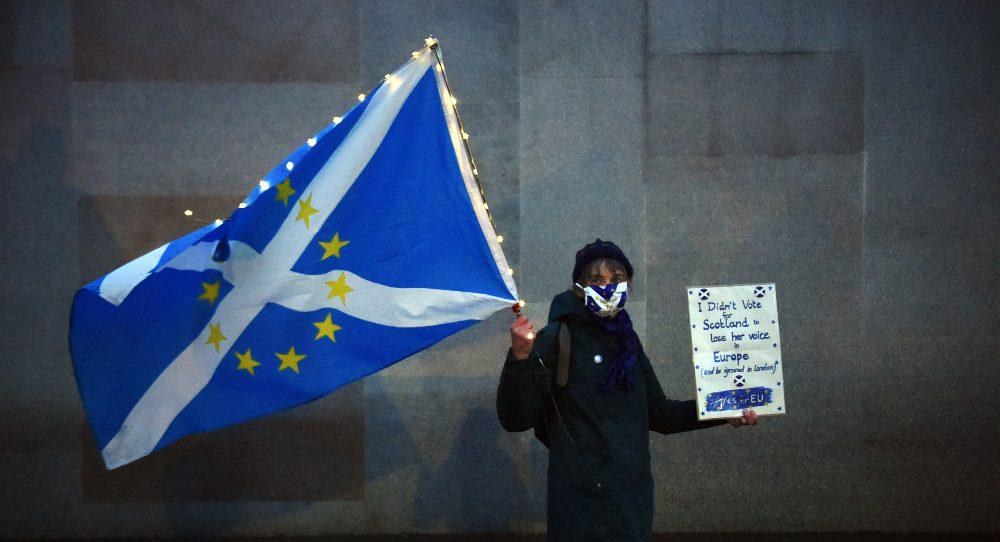
On 23 June 2016, 51.9 % o British voters voted for to quat the European Union. But ahint this naetional majority lay a deep tiriatorial divide : in Scotland, 62 % o voters wanted for to bide in the EU, as did 55.8 % in Northern Ireland.1 Ten year on, the quaesten o their constitutional futer comes back to the forerint : polls conductit atween late May an August 2026 put "aye" for Scottish independence atween 47 an 49 %, ahint "no" (43 to 45 %), while support for independence in Wales (26 % in Januar 2026) an for Irish unity in Northern Ireland (35.8 % in May 2026) bides a distinct minority.234 On 14 September 2026, in Cardiff, leaders o the Scottish National Party (SNP), Plaid Cymru an Sinn Féin signed a jynt memorandum caain for to strenthen their cooperation an for to easen constitutional chynge in their respective tiriatories, as well as affirmin their wull to renewal an strenthen relations with Europe, in envisaginn a futer inside the European Union.5
This initiative raises a fundamental quaesten : coud Brexit, supposed for to re-define the Unitit Kinrick's relations with Europe, ultimately contribute to its ain fragmentation an open the path to new EU accessions, thus alterin the scope o the Union ?
Atween independence claims, the richt to self-determination, an legal obstacles, sic a shift wad overhail British poleetical balances, but likeweise the institutional an economic prospects o the Union. The thesis uphauden here is that the memorandum forms a strang poleetical signal, but that the legal an European paths o the three naetions are too differin to speak o a commoun front tourd accession.
To unnerstand the stakes o this possible recomposition, ane must first look back at the historical trajectories o Scotland, Wales, an Northern Ireland, as well as the consequences o Brexit for each o thae tiriatories (I). Next, attention must be gien to the ambitions an claims set out in the jynt memorandum (II), before analysin the conditions for a possible accession to the European Union an its consequences for the EU (III).
I. Three naetional trajectories in the face o Brexit
The Unitit Kinrick, formed gradually through several unions, brings thegither four naetions with differin historical identities an constitutional aspirations. While Brexit has revived tensions atween London an the devolved governments, thae belong to a far langer history. Devolution, set up in the late 1990s, gied Scotland, Wales an Northern Ireland their ain parliaments or assemblies an governments, but constitutional maiters, stairtin with the union atween the naetions, remain reserved powers at Westminster, which shapes the hail o the analysis that follows.67
Graphique interactif — les données figurent ci-dessous.
Données du graphique
| Tiriatory | Bide in the EU | Leave the EU |
|---|---|---|
| Scotland | 62 % | 38 % |
| Wales | 47,5 % | 52,5 % |
| Northern Ireland | 55,8 % | 44,2 % |
| Unitit Kinrick | 48,1 % | 51,9 % |
A. Scotland, at the hairt o a contestit union
Independent for several centuries, the Kinrick o Scotland joined with Ingland in 1707, through an Act o Union that merged the two Parliaments to form the Kinrick o Great Britain, while keepin distinct institutions, in particular its legal system, its Kirk, an its eddication system. Scottish naetional sentiment bides a central element o poleetical debait today. In the 2014 independence referendum, 55.3 % o voters nevertheless chose to bide inside the Unitit Kinrick, on a turnout o 84.6 %.8 Two year later, Scots voted to remain in the European Union by 24 points ahead o Brexit.1 This gap strenthened the arguments o the SNP, which presents independence as a way to allow Scotland to find its place in the EU aince mair.
The current balance o power is mair favorable to pro-independence forces than in 2014 without givin them an overall majority in Parliament on their ain. In the May 2026 elections, the SNP won 58 o the 129 seats, six fewer than in 2021, with a turnout o 53.2 % ; with the 15 Green MSPs, pro-independence parties nevertheless regain a majority (73 seats).9
Graphique interactif — les données figurent ci-dessous.
Données du graphique
| Group | Seats |
|---|---|
| Greens | 15 seats |
| Labour | 17 seats |
| SNP | 58 seats |
| Liberal Democrats | 10 seats |
| Conservatives | 12 seats |
| Reform UK | 17 seats |
But a legal obstacle bides : in 2022, the UK Supreme Court ruled, in the judgment Reference by the Lord Advocate o 23 November, that the Scottish Parliament coud not organize a new independence referendum on its ain.6 As for public opinion, 2026 polls differ by polling company : YouGov an Ipsos still show "no" ahead in spring, whereas Survation, Find Out Now, an Norstat place "aye" atween 47 an 49 % in summer, or around 52 % to 48 % aince undecideds are excluded.2
Graphique interactif — les données figurent ci-dessous.
Données du graphique
| Company and fieldwork period (2026) | Aye | No |
|---|---|---|
| YouGov (24 Apr-5 May) | 40 % | 46 % |
| Ipsos (1-4 May) | 42 % | 46 % |
| Norstat (27-29 May) | 49 % | 45 % |
| Find Out Now (4-10 Aug) | 48 % | 45 % |
| Survation (13-24 Aug) | 47 % | 43 % |
B. Wales, frae a quest for autonomy to independence
Gradually integrated into the Kinrick o Ingland in the 16th century by the Laws in Wales Acts o 1535 an 1542, Wales possesses a strang cultural an linguistic identity. Its poleetical autonomy developed later : in 1997, Welsh voters narrowly approved the creation o a devolved assembly with 50.3 % o the vote on a turnout o around 50 %.10 Unlike Scotland, Wales voted for Brexit in 2016 by 52.5 % to 47.5 % for Remain.1 This result does not, however, allow the conclusion that Welsh voters reject all European cooperation, even if no recent poll measures support for EU accession for an independent Wales. Debaits on agricultural fundin, regional development, an economic ties with the EU continue to feed reflection on the tiriatory's futer. Plaid Cymru, the Welsh naetionalist party, now uphauds independence an closer European ties.
The Welsh scenario shouldna be put on the same level as the Scottish scenario, as support for independence bides a minority : 26 % versus 54 % in a YouGov poll frae Januar 2026, an 35 % versus 50 % in a Redfield and Wilton survey frae March 2025.3 Yet the Senedd elections o 7 May 2026 placed Plaid Cymru first for the first time, with 43 o the 96 seats (35.4 % o the vote), ahead o Reform UK (34 seats). Rhun ap Iorwerth leads a minority government, and has ruled out an independence referendum in this first term, while maintainin this long-term goal.11
Graphique interactif — les données figurent ci-dessous.
Données du graphique
| Group | Seats |
|---|---|
| Greens | 2 seats |
| Plaid Cymru | 43 seats |
| Labour | 9 seats |
| Liberal Democrats | 1 seats |
| Conservatives | 7 seats |
| Reform UK | 34 seats |
C. Northern Ireland, atween British identity an the prospect o a reunited Ireland
Created in 1921 durin the partition o the island o Ireland, Northern Ireland remains deeply marked by the coexistence o communities with differin constitutional aspirations : unionists wish to maintain the link with the Unitit Kinrick, while Irish naetionalists advocate the reunificaiton o the island. This two-camp overview remains schematic, as the unionist camp brings thegither the DUP, the UUP, and the TUV, an a section o the electorate identifies neither as unionist nor naetionalist, as reflectit in the vote for the Alliance party.4 The Good Friday Agreement o 1998 laid the foundations for the peace process and established the principle o consent in any change to the tiriatory's constitutional status. In 2016, 55.8 % o Northern Irish voters chose to remain in the EU.1 Brexit subsequently complicated trade relations atween Great Britain, Northern Ireland, an the Republic o Ireland, an EU member. The Windsor Framework (2023) sought to ease thae difficulties while preserving the absence o a hard border on the island.
Sinn Féin came out top in the Northern Ireland Assembly elections in 2022 with 27 o the 90 seats, a first for an Irish naetionalist party, and its vice-president Michelle O'Neill has been First Minister since Februar 2024.12 Public opinion nevertheless lags ahint this electoral success : the survey by the Institute of Irish Studies at the University o Liverpool, conducted in May 2026, puts support for Irish unity at 35.8 %, its lowest level in ten year, down frae 40.6 % in 2025.4 In this context, Sinn Féin uphauds reunification with the Republic o Ireland, an objective distinct frae Scottish an Welsh projects, which raises a radically differin European quaesten.
Thus, while thae three naetions share certain demands today regarding self-determination, their trajectories an objectives remain distinct. Brexit made thae divergences mair visible, without however provin that a majority o their inhabitants now wish to leave the Unitit Kinrick : only Scotland comes close to it, as summarized in the table below. The next section therefore examines the memorandum signed in Cardiff, its content an its limits.
| Naetion | 2016 vote to remain in the EU | Current support for constitutional chynge |
|---|---|---|
| Scotland | 62.0 % | 47 % for independence vs 43 % (Survation, August 2026) |
| Wales | 47.5 % | 26 % for independence vs 54 % (YouGov, Januar 2026) |
| Northern Ireland | 55.8 % | 35.8 % for Irish unity (University o Liverpool, May 2026) |
II. A poleetical rapprochement without a commoun project
The three parties took a new step in their cooperation by signin, in Cardiff on 14 September 2026, a Memorandum of Understanding. The signatories are John Swinney, leader o the SNP and Scottish First Minister, Rhun ap Iorwerth, leader o Plaid Cymru and Welsh First Minister, an Michelle O'Neill, vice-president o Sinn Féin and First Minister o Northern Ireland, who signed in their capacity as party leaders, excludin their government roles.5 The SNP and Plaid Cymru have long cooperated at Westminster, where Sinn Féin does not sit due to its abstentionist policy, so that the novelty lies in the union o the three parties in a single text. Their goal : to coordinate their efforts to achieve constitutional chynge in their respective tiriatories an defend the richt o their populations to determine their futer. The text explicitly calls on the UK government to "prepare for, plan and facilitate constitutional change" (in English, "prepare for, plan and facilitate constitutional change", author's translation frae the quote reported by ITV News).5
This rapprochement is based on a shared finding by the signatories : Brexit has allegedly weakened their economies and reduced opportunities for their populations. This diagnosis is that o the parties themselves, but finds support in estimates frae the Office for Budget Responsibility, which considers that the Trade and Cooperation Agreement will reduce British productivity by 4 % in the long run an trade by around 15 % compared with EU membership.13 The economic cost o Brexit is analyzed in mair detail in the PromethEUs article Why the United Kingdom should rejoin the EU. The memorandum therefore intends to strenthen their cooperation in three main areas : economic development and the fecht against inequality, the exploitation o their renewable energy resources, and European and international relations. Cooperation on energy mainly covers offshore wind in the North Sea, the Irish Sea, and the Celtic Sea ; it appears realistic for investment, research, an supply chains, but remains limited by the fact that energy regulation is largely a matter for Westminster.
The central point o the memorandum lies in the nature o this coordination. Despite this wull to cooperate, the document explicitly acknowledges that the parties uphaud distinct constitutional projects. The SNP wants independence for Scotland, Plaid Cymru for Wales, while Sinn Féin advocates the reunification o Ireland, which wad imply joining Northern Ireland to the Republic o Ireland, already an EU member. The memorandum sets neither a commoun timetable nor a uniform procedure : each naetion must be able to determine its futer "in its own way and in its own time".5
This distinction is fundamental, as the legal obstacles are not the same. In Scotland, the obstacle is the 2022 ruling mentioned above. In Wales, a referendum wad likeweise require an appropriate legal basis and intervention by UK institutions : the Wales Act 2017 lists among reserved matters "the union o the naetions o Wales and England", so that an enablin act passed at Westminster wad be necessary, as before the 2014 Scottish referendum, and the quaesten has never been ruled on by a court.7 In Northern Ireland, the Good Friday Agreement provides a democratic path tourd reunification, with the possibility o a referendum on Irish unity when the conditions set out in the agreement are met. The Secretary o State for Northern Ireland must call this referendum if it appears likely to them that a majority o voters wish Northern Ireland to cease to be part o the UK to join a united Ireland, an cannot organize a new one less than seven year eftir the previous one.14 On the Irish side, Articles 2 and 3 o the Constitution make the realization o a united Ireland subject to the consent o a majority in both jurisdictions on the island, which assumes a parallel vote in the North and South.15
| Naetion | Legal obstacle or mechanism | Decidin authority |
|---|---|---|
| Scotland | Reserved power o the UK Parliament : Supreme Court ruling o 23 November 2022 | UK Parliament (Westminster) |
| Wales | The union o the naetions o Wales and England is a reserved matter (Wales Act 2017) ; quaesten unruled on by a court | UK Parliament, through an enablin act |
| Northern Ireland | Mechanism provided by the Good Friday Agreement and the Northern Ireland Act 1998 (Schedule 1) | Secretary o State for Northern Ireland, with a parallel vote in the Republic o Ireland |
The memorandum is an instrument o cooperation an poleetical pressure. It proclaims no independence and initiates no secession process. Its scope lies in the stated intent to coordinate movements hitherto engaged in distinct trajectories and to place the constitutional quaesten at the heart o British debait. Initial reactions confirm this poleetical reading. According to ITV News, Downing Street indicates that Prime Minister Andy Burnham is committed to the Union and will not engage in new referendums, with a letter addressed to John Swinney keepin a Scottish referendum "off limits", although Mr Burnham mentioned in the Commons the possibility o a new vote in the event o a "clear consensus" in Scotland. Northern Ireland Deputy First Minister Emma Little-Pengelly (DUP) for her part accuses Michelle O'Neill o using the office o First Minister for party-political ends.165 Available reports do not, at this stage, record any reaction frae the Irish government or European institutions.
Beyond challengin the territorial organization o the Unitit Kinrick, the text presents Europe as a commoun poleetical horizon : the signatories state that "the future of our nations belongs in the European Union".5 But a poleetical wull to join the EU is not equivalent to an official application, an even less so to guaranteed accession. Only a State can lodge an application under Article 49 o the Treaty on European Union : neither Scotland nor Wales can do so while they remain part o the Unitit Kinrick.17
Any possible independence or reunification wad thus open a period o complex negotiations, focusing in particular on the international status o the new States, their relations with the Unitit Kinrick, and their futer relations with the Union, namely in concrete terms the sharing o debt and assets, currency, the border with Ingland, the Common Travel Area with Ireland, the British nuclear deterrent based in Scotland, and NATO membership. For the Twenty-Seven, it wad be necessary to decide whether to accept new members an under what conditions.
The Cardiff memorandum thus marks an important poleetical step, without prejudging its outcome. It transforms naetional claims into a mair structured cooperation project and relaunches a quaesten that goes far beyond British borders. It remains to examine what this wad entail for the Union.
III. Accession an consequences for the European Union
A. A possible accession, but far frae automatic
An independent Scotland or a sovereign Wales wad not automatically retain the member status that the Unitit Kinrick enjoyed. In 2012, Commission President José Manuel Barroso wrote that a new independent State wad, by the very fact o its independence, become a third country with respect to the Union, and a Commission spokesperson confirmed this position in March 2017.18 Each wad, in principle, have to go through the procedure provided for in Article 49 o the Treaty on European Union : lodging an application, negotiations on the adoption o the acquis communautaire, unanimous agreement o member States, and ratification o the accession treaty by each o them according to their constitutional rules, which makes the process langer an mair uncertain than the negotiations alone.19 No direct precedent exists for a State arrising frae the secession o a member State, leaving the Union without an established doctrine on this case.
The candidate wad likeweise have to meet the Copenhagen criteria, which require stable institutions, a viable market economy, an the capacity to assume the acquis, includin adherence to the aims o poleetical, economic, an monetary union.20 For Scotland, thae criteria are at the heart o the current debait, in particular the public deficit and currency. According to the GERS 2025-26 report, Scotland's notional deficit reaches 10.9 % o GDP, compared to 4.2 % for the UK, whereas the treaties set a reference value o 3 % for public deficit.21 New member States commit in principle to adopt the euro as soon as they meet the conditions, which wad raise the quaesten o currency, while the Schengen quaesten wad run up against the Common Travel Area with Ireland.
Graphique interactif — les données figurent ci-dessous.
Données du graphique
| Reference | Public deficit |
|---|---|
| Scotland (notional deficit) | 10,9 % |
| Unitit Kinrick | 4,2 % |
| Treaty reference value | 3 % |
Finally, the timetable wad depend on the wull o each capital. Unanimity gies each member State a veto richt, an thae facing internal territorial claims, Spain being regularly cited, wad examine the precedent closely. To judge the duration o sic a process, Croatia, a candidate in 2003, joined in 2013, an several candidates in the Western Balkans have been waiting for over fifteen year.
The Northern Irish scenario wad be differin : reunification with the Republic o Ireland wad raise a distinct legal quaesten, linked to the Good Friday Agreement and the European status o the island. At the summit o 29 April 2017, the Twenty-Seven had a declaration recorded in the minutes o the European Council recognizing that an agreed mechanism enables a united Ireland to be achieved by peaceful and democratic means, an that "the entire territory of such a united Ireland would thus be part of the European Union".22 This declaration, distinct frae the negotiating guidelines adopted the same day,23 expresses a poleetical position o the Twenty-Seven, without treaty value, and sets the direction that a negotiation wad likely follow. The legal context is suited to it : Articles 2 and 3 o the Irish Constitution already target the hail island, and inhabitants o Northern Ireland can already obtain Irish, an therefore European, citizenship.15 No third application wad be necessary : the territory o the Union wad extend to the hail island.
B. New representation inside European institutions
The arrival o new member States wad alter the institutional balances o the Union. Scotland and Wales coud directly defend their interests in the Council o the EU, take part in the work o the European Council, an have representation in the European Parliament. They wad likeweise take part in forming the European Commission according to the rules applicable to member States : to date, each member State has one commissioner, one head o State or government in the European Council, an one judge at the Court o Justice.
Orders o magnitude help appreciate this weight. Scotland has around 5.55 million inhabitants24 and Wales around 3.19 million.25 The European Parliament for the 2024-2029 term allocates 14 seats to Ireland, 15 to Slovakia, Denmark, and Finland, and 12 to Croatia, States o a size close to that o Scotland, an 12 to Croatia, mair populous than Wales.26 As an order o magnitude, one can therefore expect around fifteen elected representatives for Scotland an around ten for Wales. The text treats both countries thegither here, but their plausibility differs sharply : with 47 to 49 % "aye" in recent polls, Scottish independence is a serious hypothesis, whereas at 26 % Welsh independence remains a distant prospect.
This development coud enrich European debaits, notably on energy, maritime, agricultural, and regional policies, whether North Sea fishing, offshore wind, the Common Agricultural Policy, or cohesion policy. But it wad also imply re-examining the distribution o parliamentary seats an decision-making balances. Treaties cap the Parliament at 750 members plus its president, an apply the principle o degressive proportionality, with a minimum o 6 an a maximum o 96 seats per State ;27 as the Parliament has 720 members since 2024, the margin is around thirty seats, which wad in principle suffice for Scotland and Wales but wad force a redistribution for any further enlairgement. The accession o new States wad chynge the map o Europe an influence compromises among the Twenty-Seven.
C. Economic opportunities, but also trade challenges
Accession to the single market coud facilitate trade in goods an services with ither member States, strenthen scientific cooperation, an allow access to European research and regional development programmes. For Scotland, whose government officially advocates future accession, entering the single market as an independent State is notably presented as a way to facilitate trade an attract investment. Scottish exports show what is at stake : in 2023, they reached £93.1 billion, o which around 59.5 % went to the rest o the UK an 18 % to the Union, excluding oil and gas,28 an this balance is the argument most often advanced by opponents o independence. At this stage, neither the memorandum nor the reports consulted detail any proposal on currency or the border.
Graphique interactif — les données figurent ci-dessous.
Données du graphique
| Destination | Exports |
|---|---|
| Rest o the Unitit Kinrick | 55,4 £bn |
| European Union | 17,1 £bn |
| Rest o the warld | 20,6 £bn |
Thae potential benefits must nevertheless be put into perspective. A Scotland in the EU an the rest o the UK outside the Union wad be subject to differin regulatory an customs frameworks. A customs an regulatory border coud appear atween Scotland an Ingland. The Windsor Framework an the Common Travel Area with Ireland show how a border atween two regulatory regimes can be managed, at the cost o specific checks an rules. Negotiations wad also need to address contributions to the EU budget, the application o single market rules, an obligations associate with accession. Scotland wad be a net contributor or beneficiary o the EU budget depending on its naetional income and amounts received under the Common Agricultural Policy an cohesion policy, which wad be subject to negotiation.
For the Union, the arrival o new members coud strenthen its presence in the North Sea, its energy capacities, particularly offshore wind, its fishery an port resources, an its diplomatic weight. The security dimension also changes strategic interest : the British nuclear deterrent is based on the Clyde, in Scotland, the SNP demands its withdrawal, and NATO membership wad become a subject o negotiation. It wad likeweise entail budget an institutional adjustments. The outcome wad be favorable to the Union provided a prior agreement settles debt, currency, an the border before any accession ; without this agreement, the Union wad import a bilateral dispute into its ain institutions.
Conclusion
Brexit opened a debait on the fragmentation o the Unitit Kinrick, but it is not enough on its ain to produce new accessions. It was intended to re-define the Unitit Kinrick's relations with the European Union, yet its consequences continue to feed debaits on the constitutional futer o its naetions. The memorandum chynges nothing in law, but it chynges the discussion : the rapprochement o the SNP, Plaid Cymru, and Sinn Féin illustrates a wull to cooperate among movements that, despite differin goals, claim greater control over their poleetical futer. Three findings emerge : the memorandum is a poleetical signal, legal paths differ by naetion, and consequences for the Union depend mainly on the Irish an Scottish cases.
A possible Scottish or Welsh independence, or Irish reunification, coud have major consequences for the European Union, frae its institutional representation to its trade relations. But thae scenarios remain subject to considerable poleetical an legal obstacles, an no accession can be taken for granted. The Irish scenario is the most advanced legally, as the consultation mechanism exists an the Twenty-Seven have already indicated that the island wad remain in the Union, although support o 35.8 % makes it uncertain. The Scottish scenario is the most uncertain, as it depends on an agreement frae Westminster an precise answers on debt, currency, and the border. The Welsh scenario is the most distant. No referendum is scheduled and Downing Street is shuttin the door ; given the ten year it took for Croatia to accede, effective accession before the mid-2030s appears unlikely.
The quaesten thus goes beyond the futer o the Unitit Kinrick alone : to what extent is the European Union ready to welcome new States while preserving its cohesion and decision-making capacity ? At a time when enlairgement returns to the center o European debait, this hypothesis invites reflection on the futer borders o the Union an the consistency atween the unanimity required for accession an the speed that a British poleetical timetable wad impose.
The Union should therefore clarify in advance its doctrine on the accession o a tiriatory arrising frae a member State, for instance in a European Council declaration that wad specify applicable criteria, the role o a separation agreement with the UK, an the status o the tiriatory durin transition, in order not to improvise on the day the case arrises.
On the economic cost o Brexit, which forms the European argument o the three parties, the editorial team invites ye to read, or re-read, our article :
References
- Elise Uberoi (2016) Analysis of the EU Referendum results 2016. Available at: https://commonslibrary.parliament.uk/research-briefings/cbp-7639/ (Accessed 14/11/2026).
- Wikipédia, tableau des sondages (2026) Opinion polling on Scottish independence. Available at: https://en.wikipedia.org/wiki/Opinion_polling_on_Scottish_independence (Accessed 14/11/2026).
- Wikipédia, tableau des sondages (2026) Opinion polling on Welsh independence. Available at: https://en.wikipedia.org/wiki/Opinion_polling_on_Welsh_independence (Accessed 14/11/2026).
- University of Liverpool, Institute of Irish Studies (2026) Northern Ireland public opinion survey shows majority wish to remain in UK. Available at: https://news.liverpool.ac.uk/2026/06/08/northern-ireland-public-opinion (Accessed 14/11/2026).
- ITV News (UTV) (2026) Westminster's time is coming to an end, SNP, Plaid and Sinn Féin leaders. Available at: https://www.itv.com/news/utv/2026-09-14/westminsters-time-is-coming-to-an-end (Accessed 14/11/2026).
- Supreme Court of the United Kingdom (2022) Reference by the Lord Advocate of devolution issues under paragraph 34 of Schedule 6 to the Scotland Act 1998 [2022] UKSC 31. Available at: https://www.supremecourt.uk/cases/uksc-2022-0098 (Accessed 14/11/2026).
- Institute for Government Welsh independence. Available at: https://instituteforgovernment.org.uk/explainer/welsh-independence (Accessed 14/11/2026).
- Wikipédia 2014 Scottish independence referendum. Available at: https://en.wikipedia.org/wiki/2014_Scottish_independence_referendum (Accessed 14/11/2026).
- Andrew Aiton; Andrew Feeney-Seale; Kayleigh Finnigan; Sarah McKay; Iain McIver; Emma Robinson (2026) Election 2026 (SB 26-26). Available at: https://www.parliament.scot/chamber-and-committees/research-prepared-for-parliament/research-briefings/2026/5/12/sb-2626/the-result (Accessed 14/11/2026).
- Wikipédia 1997 Welsh devolution referendum. Available at: https://en.wikipedia.org/wiki/1997_Welsh_devolution_referendum (Accessed 14/11/2026).
- Wikipédia (2026) 2026 Senedd election. Available at: https://en.wikipedia.org/wiki/2026_Senedd_election (Accessed 14/11/2026).
- Wikipédia (2022) 2022 Northern Ireland Assembly election. Available at: https://en.wikipedia.org/wiki/2022_Northern_Ireland_Assembly_election (Accessed 14/11/2026).
- Office for Budget Responsibility Brexit analysis. Available at: https://obr.uk/forecasts-in-depth/the-economy-forecast/brexit-analysis/ (Accessed 14/11/2026).
- legislation.gov.uk Northern Ireland Act 1998, Schedule 1: Polls for the purposes of section 1. Available at: https://www.legislation.gov.uk/ukpga/1998/47/schedule/1 (Accessed 14/11/2026).
- Irish Statute Book Constitution of Ireland, articles 2 and 3. Available at: https://www.irishstatutebook.ie/eli/cons/en/html (Accessed 14/11/2026).
- ITV News (UTV) (2026) Leaders of Sinn Féin, Plaid Cymru and SNP to sign independence pledge. Available at: https://www.itv.com/news/utv/2026-09-14/sinn-fin-plaid-cymru-and-snp-leaders-to-sign-independence-pledge (Accessed 14/11/2026).
- EUR-Lex Traité sur l'Union européenne (version consolidée), article 49. Available at: https://eur-lex.europa.eu/legal-content/FR/TXT/?uri=CELEX:12016M049 (Accessed 14/11/2026).
- Full Fact Could an independent Scotland stay in the EU?. Available at: https://fullfact.org/law/can-scotland-stay-in-eu/ (Accessed 14/11/2026).
- Commission européenne, Direction générale du voisinage et des négociations d'élargissement Steps towards joining. Available at: https://enlargement.ec.europa.eu/enlargement-policy/steps-towards-joining_en (Accessed 14/11/2026).
- Commission européenne, Direction générale du voisinage et des négociations d'élargissement Conditions for membership. Available at: https://enlargement.ec.europa.eu/enlargement-policy/conditions-membership_en (Accessed 14/11/2026).
- Scottish Financial News Scottish revenue at £98bn as notional deficit falls. Available at: https://www.scottishfinancialnews.com/articles/scottish-revenue-at-ps98bn-as-notional-deficit-falls (Accessed 14/11/2026).
- Houses of the Oireachtas (2017) Written answer on the European Council statement on a united Ireland, 2 May 2017. Available at: https://www.oireachtas.ie/en/debates/question/2017-05-02/632/ (Accessed 14/11/2026).
- Conseil européen (2017) European Council (Art. 50) guidelines for Brexit negotiations. Available at: https://www.consilium.europa.eu/en/press/press-releases/2017/04/29/euco-brexit-guidelines/ (Accessed 14/11/2026).
- National Records of Scotland (2024) Scotland's population reached 5.55 million on 30 June 2024. Available at: https://nrscotland.gov.uk/publications/mid-2024-population-estimates (Accessed 14/11/2026).
- Welsh Government (2024) Mid-year estimates of the population: 2024. Available at: https://www.gov.wales/mid-year-estimates-population-2024-html (Accessed 14/11/2026).
- Wikipédia 2024 European Parliament election, composition by member state. Available at: https://en.wikipedia.org/wiki/2024_European_Parliament_election (Accessed 14/11/2026).
- EUR-Lex Traité sur l'Union européenne (version consolidée), article 14. Available at: https://eur-lex.europa.eu/legal-content/FR/TXT/?uri=CELEX:12016M014 (Accessed 14/11/2026).
- Scottish Government Export Statistics Scotland 2023. Available at: https://www.gov.scot/publications/exports-statistics-scotland-2023/ (Accessed 14/11/2026).
Nae comments yet.