 GR



0 Μου αρέσει
Γίνετε ο πρώτος που θα δηλώσει ότι του αρέσει
Ευρωπαϊκή ανάλυση, 23 Οκτωβρίου 2026 — Serbia: Understanding the political crisis ahead of the 25 Oct. 2026 elections
prometheus.fr 🇷🇸 SERBIA | Political crisis: Can the students end fourteen years of SNS dominance?
Since the Novi Sad disaster in November 2024, the student movement has become a national political force, denouncing corruption and calling for more transparent institutions. The rally in Belgrade on 22 October, just three days before the parliamentary elections, illustrates the scale of this mobilisation.
⚖️ But with an uneven electoral playing field, concerns over the integrity of the vote and uncertainty about the movement’s ability to govern, the outcome of this confrontation remains uncertain.
🇪🇺 Beyond domestic politics, the crisis also raises questions about the rule of law, relations with Brussels and Serbia’s European future.
🔎 In this analysis, we examine the origins of the mobilisation, the students’ demands, Serbia’s political system and the stakes of the 25 October elections.
PromethEUs | Making sense of European affairs.
#Serbia #Belgrade #Politics #Democracy #Elections #StudentMovement #AntiCorruption #RuleOfLaw #EuropeanUnion #Geopolitics #PromethEUs
Sources
2. Reuters, AFP
3. Reuters, Serbian Government
4. OSW, Reuters
5. Reuters, The Guardian
6. OSW, Reuters
7. Reuters, OSW
8. CRTA
9. CRTA
10. CRTA, Associated Press, OSCE/ODIHR
11. European Commission, Reuters
12. OSCE/ODIHR, Reuters, AP
Διάβασε αυτό το καρουζέλ ως κείμενο
-
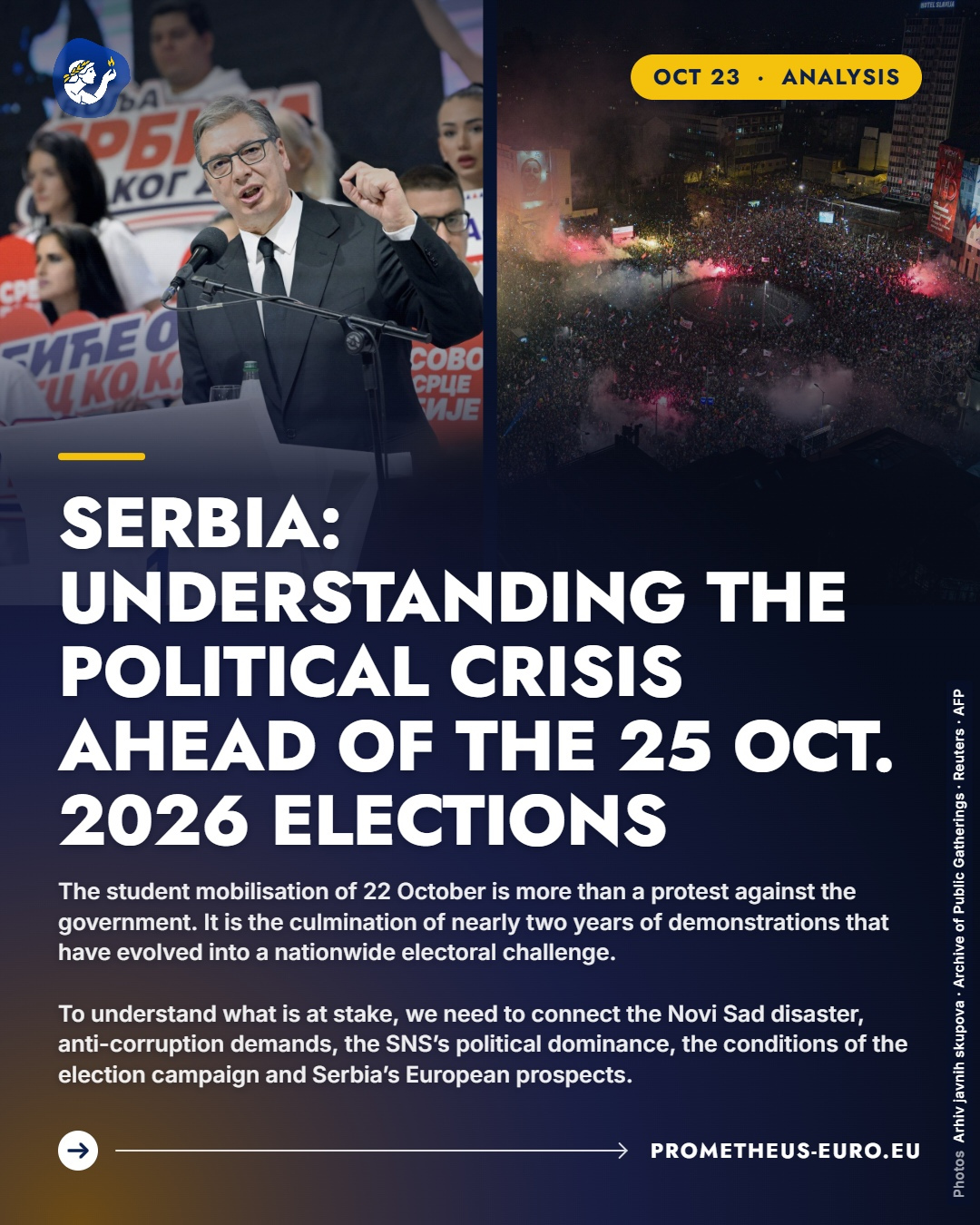
Serbia: Understanding the political crisis ahead of the 25 Oct. 2026 elections
The student mobilisation of 22 October is more than a protest against the government. It is the culmination of nearly two years of demonstrations that have evolved into a nationwide electoral challenge.
To understand what is at stake, we need to connect the Novi Sad disaster, anti-corruption demands, the SNS’s political dominance, the conditions of the election campaign and Serbia’s European prospects. -
From Novi Sad to the ballot box
On 25 October, Serbian voters will elect their Parliament in a snap election contested by, among others, the Serbian Progressive Party (SNS), associated with Aleksandar Vučić, and the student list “Student List – Students Are Winning” (“*Studentska lista*”).
The movement emerged following a railway disaster in November 2024. It has gradually developed into a national political force, challenging alleged corruption and the functioning of state institutions. The rally in Belgrade on 22 October, the students’ final major campaign event, illustrates the scale of the mobilisation.Πηγή : Reuters, AFP
-
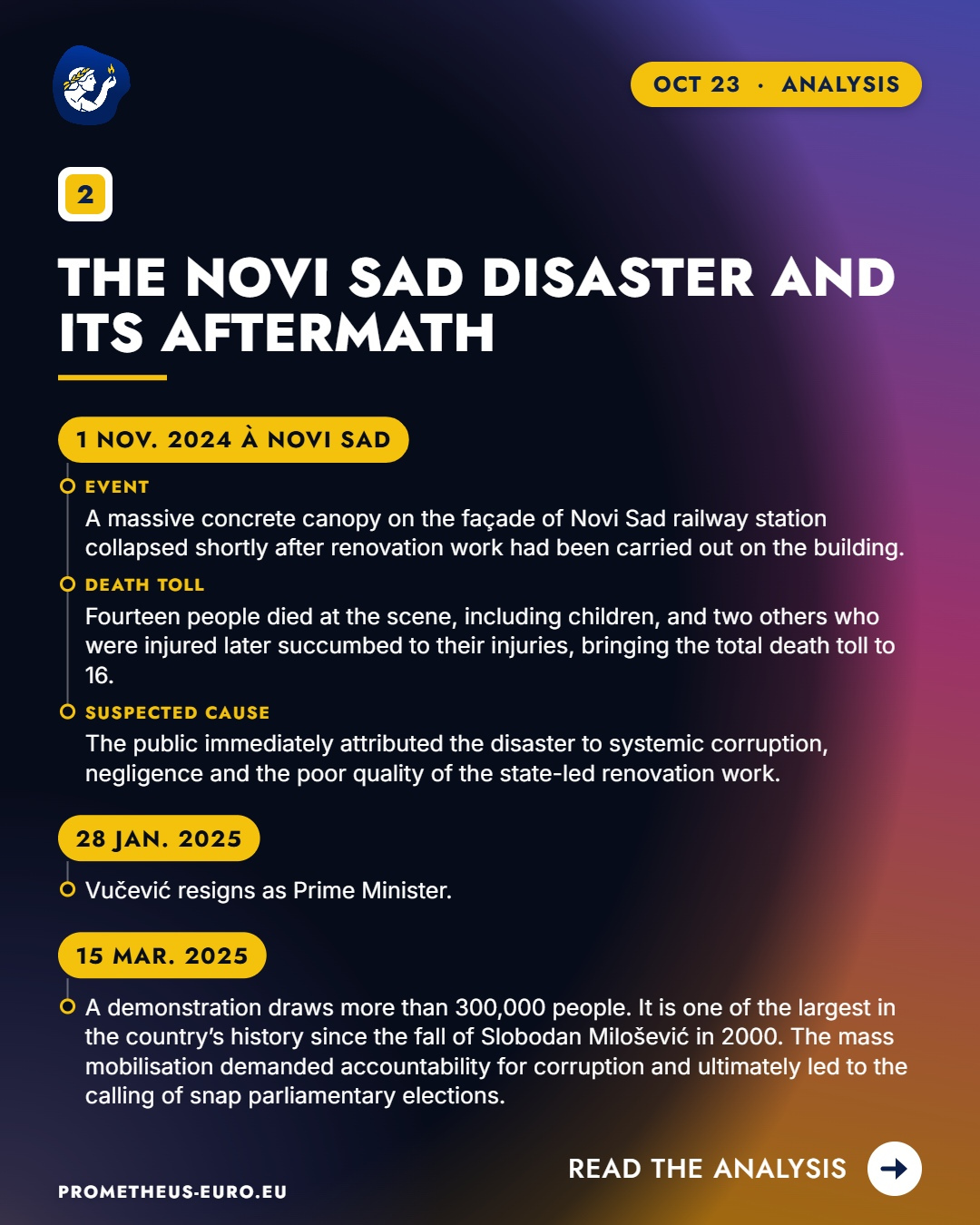
The Novi Sad disaster and its aftermath
1 Nov. 2024 à Novi Sad
Event : A massive concrete canopy on the façade of Novi Sad railway station collapsed shortly after renovation work had been carried out on the building.
Death toll : Fourteen people died at the scene, including children, and two others who were injured later succumbed to their injuries, bringing the total death toll to 16.
Suspected cause : The public immediately attributed the disaster to systemic corruption, negligence and the poor quality of the state-led renovation work.
28 Jan. 2025
: Vučević resigns as Prime Minister.
15 Mar. 2025
: A demonstration draws more than 300,000 people. It is one of the largest in the country’s history since the fall of Slobodan Milošević in 2000. The mass mobilisation demanded accountability for corruption and ultimately led to the calling of snap parliamentary elections.Πηγή : Reuters, Serbian Government
-
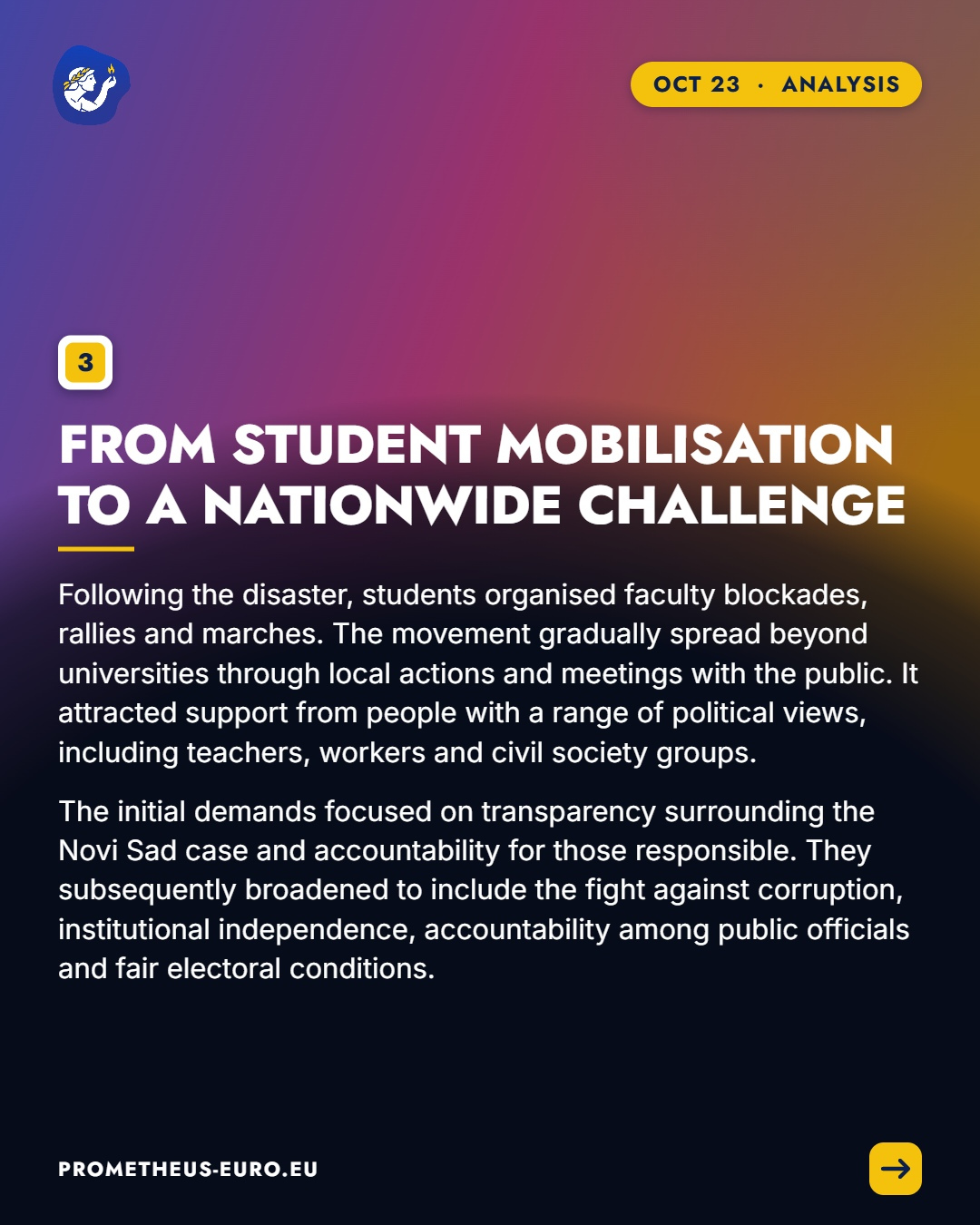
From student mobilisation to a nationwide challenge
Following the disaster, students organised faculty blockades, rallies and marches. The movement gradually spread beyond universities through local actions and meetings with the public. It attracted support from people with a range of political views, including teachers, workers and civil society groups.
The initial demands focused on transparency surrounding the Novi Sad case and accountability for those responsible. They subsequently broadened to include the fight against corruption, institutional independence, accountability among public officials and fair electoral conditions.Πηγή : OSW, Reuters
-
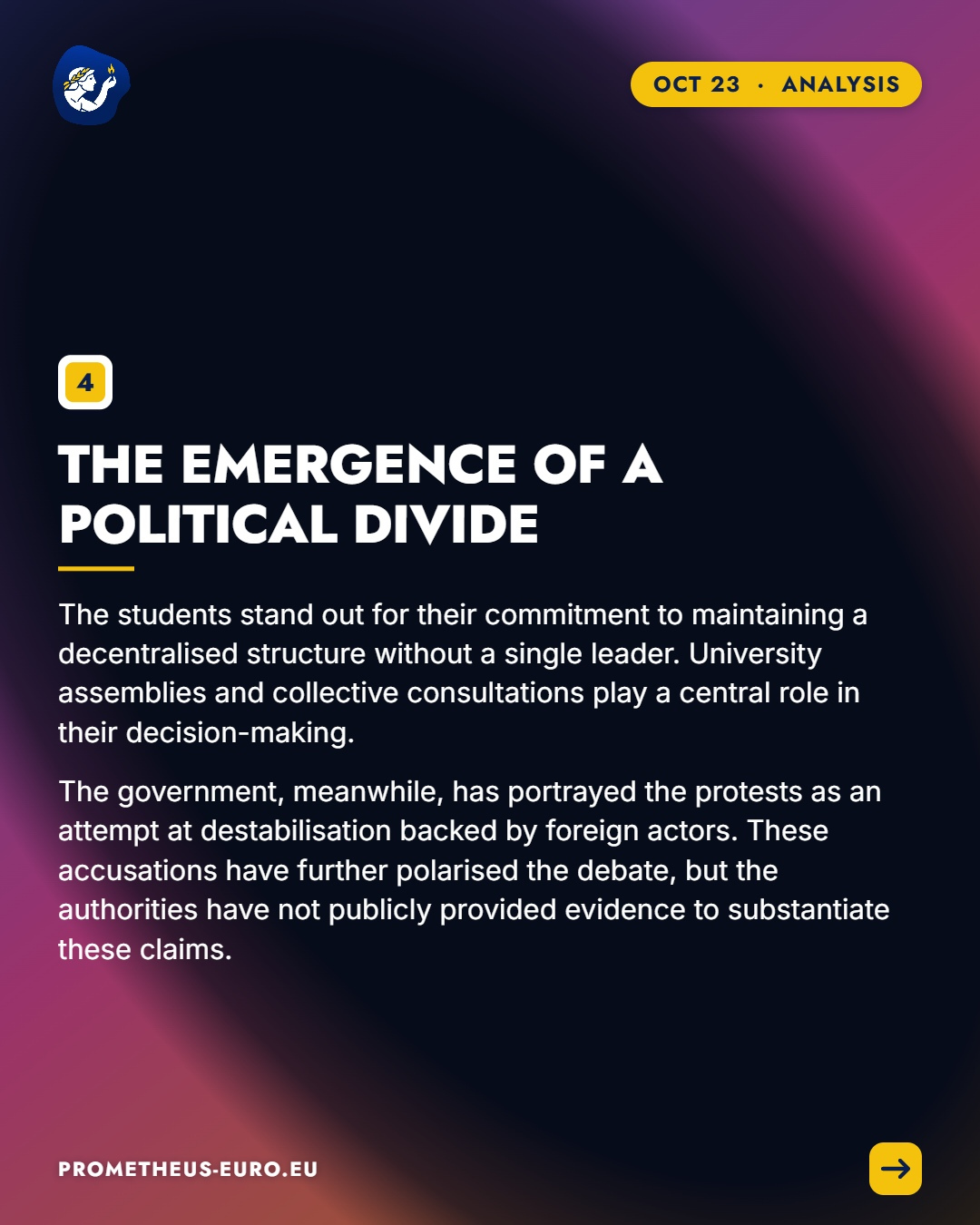
The emergence of a political divide
The students stand out for their commitment to maintaining a decentralised structure without a single leader. University assemblies and collective consultations play a central role in their decision-making.
The government, meanwhile, has portrayed the protests as an attempt at destabilisation backed by foreign actors. These accusations have further polarised the debate, but the authorities have not publicly provided evidence to substantiate these claims.Πηγή : Reuters, The Guardian
-
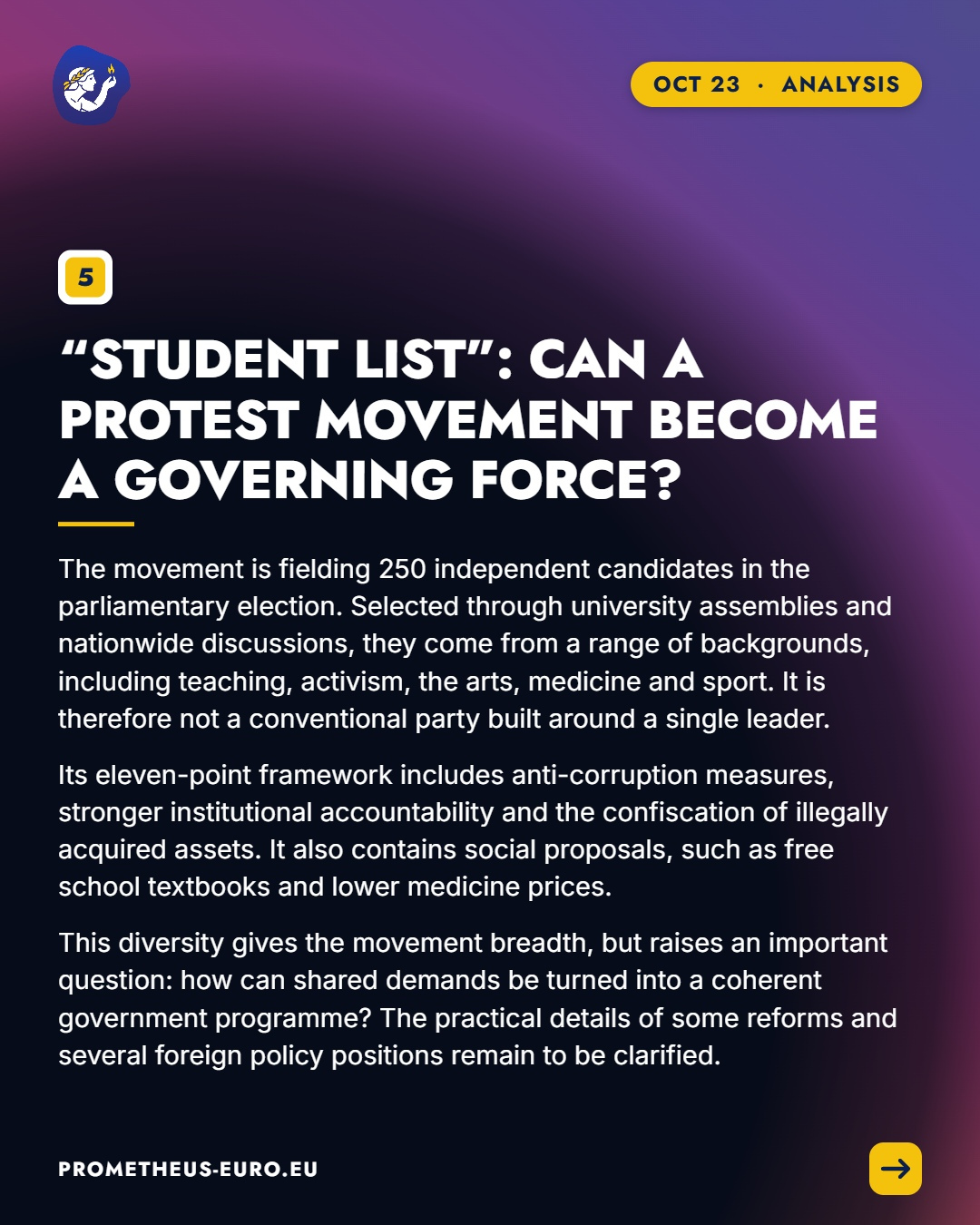
“Student List”: Can a protest movement become a governing force?
The movement is fielding 250 independent candidates in the parliamentary election. Selected through university assemblies and nationwide discussions, they come from a range of backgrounds, including teaching, activism, the arts, medicine and sport. It is therefore not a conventional party built around a single leader.
Its eleven-point framework includes anti-corruption measures, stronger institutional accountability and the confiscation of illegally acquired assets. It also contains social proposals, such as free school textbooks and lower medicine prices.
This diversity gives the movement breadth, but raises an important question: how can shared demands be turned into a coherent government programme? The practical details of some reforms and several foreign policy positions remain to be clarified.Πηγή : OSW, Reuters
-
Aleksandar Vučić and Serbia’s political system
The SNS has been in power since 2012, and Aleksandar Vučić has dominated Serbian politics for more than a decade, first as Prime Minister and then as President from 2017.
On 27 September 2026, Vučić resigned as President to lead his list’s parliamentary campaign and seek the post of Prime Minister. Ana Brnabić, the Speaker of Parliament, is serving as acting President. A separate presidential election is due to be held before the end of the year.
His opponents accuse him of concentrating power, putting pressure on the media and weakening checks and balances. The government rejects these accusations and points to stability, infrastructure development and its economic record.Πηγή : Reuters, OSW
-
Electoral conditions at the heart of the controversy
In its pre-election report published on 22 October, the independent Serbian organisation CRTA describes a campaign marked by intimidation, violence, pressure on voters and highly unequal access to the media.
During the period covered, its observers recorded 116 incidents of physical or verbal violence across 34 cities and municipalities. The authorities also received more favourable media coverage.
These findings concern the conditions under which the election is being contested. They do not, by themselves, prove that the result will be fraudulent.Πηγή : CRTA
-
A significant imbalance in media coverage
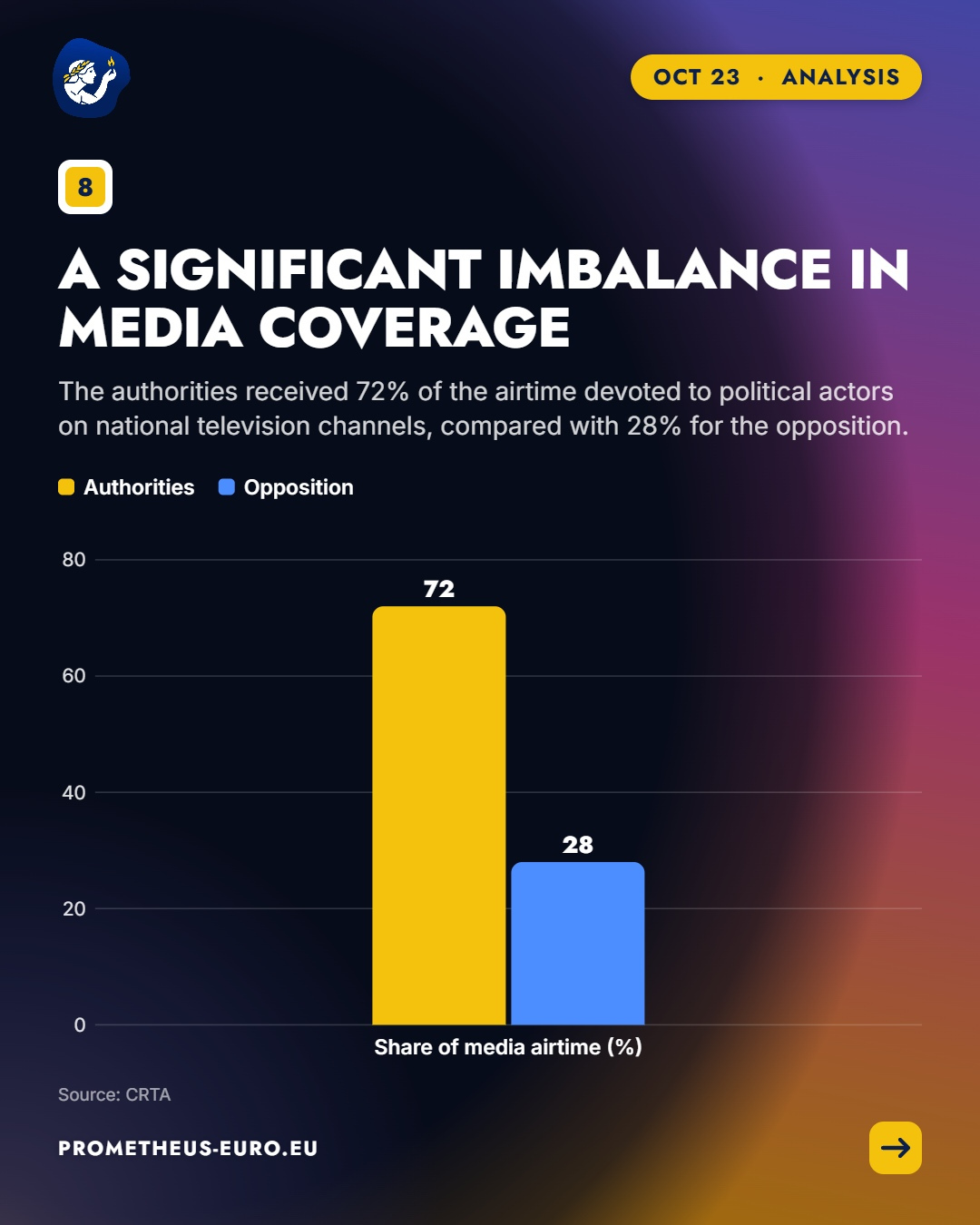
The authorities received 72% of the airtime devoted to political actors on national television channels, compared with 28% for the opposition.
Πηγή : CRTA
-
Electoral integrity
According to CRTA, the electoral register was closed with 6,450,523 voters and had not been audited beforehand. The organisation also reported incorrectly listed polling station addresses and potential obstacles to voting. These issues make it harder to verify the reliability of the electoral process.
The OSCE/ODIHR, the European Union and representatives of the Council of Europe have also expressed concerns about campaign violence, threats, the safety of journalists and observers, allegations of surveillance and the accuracy of electoral rolls.Πηγή : CRTA, Associated Press, OSCE/ODIHR
-
Why the crisis also matters to the European Union
Serbia has officially been a candidate for European Union membership since 2009. Its path towards accession nevertheless remains hindered by concerns about judicial independence, the fight against corruption, media pluralism and checks and balances.
In its 2026 Rule of Law Report, published in July, the European Commission highlighted persistent concerns about the autonomy of the prosecution service and political pressure on the judiciary.
The geopolitical dimension further complicates matters: Belgrade maintains close relations with Russia and China while continuing to pursue EU membership.Πηγή : European Commission, Reuters
-
The vote: the first step in an uncertain transition
The election will not automatically resolve Serbia’s political crisis. Several factors will be decisive: turnout, the conduct of the vote, any challenges to the result, the response of state institutions and the ability of the different lists to secure a parliamentary majority.
An electoral victory would not, by itself, guarantee that the student list could govern without difficulty. Conversely, a contested result could trigger further protests. These are possible scenarios, not foregone outcomes.
The OSCE/ODIHR is due to present its preliminary findings on 26 October. Another milestone lies ahead: following Vučić’s resignation, a presidential election must be held before the end of 2026.Πηγή : OSCE/ODIHR, Reuters, AP