
 EN
Contents
Since his reelection in 2024, Donald Trump has been leading an assumed authoritarian drift, characterized by increased centralization of power in the hands of the executive and a marked politicization of the judiciary. The businessman has constantly multiplied attacks against traditional media and checks and balances. As analyzed by Jérôme Viala-Gaudefroy, professor at Sciences Po, in an article published on The Conversation:
« Trump promises power, revenge, nostalgia for a triumphant white, Christian, and masculine America. »
This shift fits into a media landscape transformed since 1996 by the creation of Fox News and the explosion of conservative talk shows, which favored the rise of conservative and neoconservative ideas, as well as the emergence of the alt-right movement. However, these upheavals are not confined to the domestic sphere; they now extend to international politics, as attested by the new American security strategy.
A Strategy of Vassalization of Europe
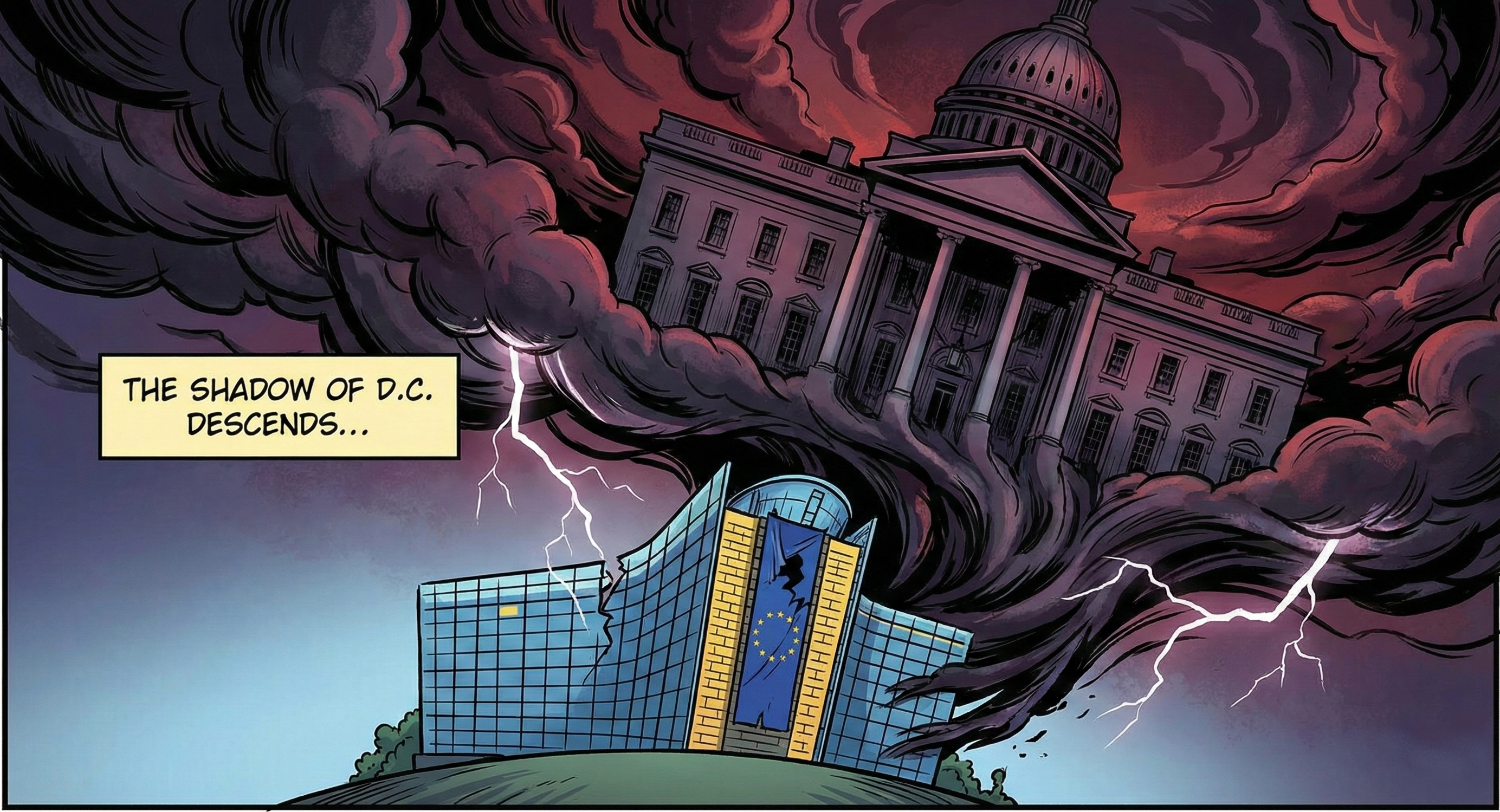
On the foreign policy front, Donald Trump intends to restore America's power and wealth by primarily preserving the "vital interests" of the United States. This America, wishing to be free and strong, positions itself as the central core of the international system around which other states orbit, vassalized and forced to align with American politics and values. The United States no longer hides its hostility towards Europeans, an animosity based on the thesis of a so-called "civilizational collapse," but also on Europe's inability to ensure its own defense.
The warning signal had already been launched during the first presidential term: Washington will no longer ensure the defense of the European Union in the name of protecting the liberal and multilateral order. The Old Continent can no longer rely on Uncle Sam for its security. The imbalances are flagrant. According to NATO data, the United States already represented 45.9% of the GNP of alliance members in 2015. Consequently, the American budget absorbs more than 70% of the total military spending of NATO countries. Conversely, many European states devote only a small part of their budget to national defense, as is the case for France (2.06%), Italy (1.49%), Belgium (1.3%), or Spain (1.28%).

NATO countries' spending in billions of USD - published by Leverage Shares EU
While the United States still portrays itself as the standard-bearer of freedom, stability, and global security, international cooperation as it may have existed during the Cold War is no longer on the agenda. In Trump's view, Europe is sliding down a dangerous "woke" slope leading to its collapse; it must therefore correct its trajectory to adopt the values of Trumpist conservatism. The objective of this strategy is to preserve the "vital" interests of the United States in the political, economic, military, and cultural fields, to the detriment of international solidarity. The strategic document also highlights the need to re-establish strict control of state borders. States must exercise unilateral and coercive control to stop "destabilizing population flows" arriving in Europe and the United States. As the text indicates:
« We want a world in which migration is not simply 'orderly,' but in which sovereign countries work together to end destabilizing population flows rather than facilitating them, and have total control over the people they accept or refuse. »
Furthermore, Trump boasts of having ended eight armed conflicts in the world and aims for total American hegemony. In this neo-imperial vision of the economy, borders are conceived as impassable barriers for populations, but porous when it comes to movements of goods, capital, and wealth. The regime of international relations is thus remodeled by and for Americans, where trade exchanges are considered a zero-sum game consisting of winners and losers.
Genesis and Expansion of the MAGA Movement
To understand this dynamic, one must return to the short history of the Make America Great Again (MAGA) movement. This slogan was invented by Republican President Ronald Reagan during the 1980 presidential election, a period marked by high unemployment and inflation rates. It was then reused by Democrat Bill Clinton during the primaries for the 1992 election. Subsequently, Donald Trump popularized this expression during the 2016 campaign, claiming paternity of this leitmotif. The MAGA movement advocates a paleoconservative ideology and relies on identity-based nationalism. This political movement, deeply anti-establishment, defends traditional values such as family, respect for social hierarchies and gender roles, as well as adherence to Christian moral values.
Caricature by Chaunu in the newspaper L'Union
Soft Power in the Age of Social Media
Trumpist America affirms its will to propagate the norms and conservative morals of the MAGA movement thanks to American soft power. This concept, developed by political scientist Joseph Nye, remains relevant and seems to have become the most powerful weapon in the era of globalization and the digital age. Social networks today belong to a handful of white American men, strongly influenced by the MAGA movement, or even expressly adhering to it. In a few clicks, politicians call out their counterparts or address their populations directly.
Trump has become the leader of this new digital political approach by tapping out raw and emotional messages, stringing together diplomatic "gaffes" and fueling Fake News at will, while appropriating digital codes (hashtags, exclamation points, capital letters, emojis). This ideological hegemony exercised by conservatives on social networks echoes the writings of Antonio Gramsci. In his Prison Notebooks, the Italian philosopher and Marxist militant explained the necessity of winning the battle of ideas before that of the ballot box. The ruling classes impose their ideas gently on the dominated classes. Gramsci thus highlighted the power of words and the way they can manipulate public opinion.

Geert Wilders, Marine Le Pen, Santiago Abascal, Viktor Orbán and Matteo Salvini during a joint meeting in Madrid, February 8, 2025. | PABLO BLAZQUEZ DOMINGUEZ / GETTY IMAGES VIA AFP
From MAGA to MEGA: The European Contagion
For a few years now, a conservative wind has been blowing over the European Union, favoring the normalization of populist far-right parties as mainstream political forces. The influence of the MAGA movement is asserting itself more and more within these formations, as evidenced by the summit held on February 7 and 8, 2025, in Madrid. Organized by the Spaniard Santiago Abascal, leader of Vox and president of the "Patriots for Europe" party, this meeting aimed to define a common strategy within European institutions. Moreover, it is notable that most of these populist parties have adopted the MAGA slogan by adapting it into the form "Make Europe Great Again" (MEGA). However, the acronym MEGA crystallizes a fundamental conflict regarding the very nature of European power.
On one side, the radical right, galvanized by the calculated provocation of Viktor Orbán who imposed this slogan during the Hungarian presidency of the EU Council, instrumentalizes the concept of a "Europe of Nations." This formula poorly conceals a strategy of methodical unraveling of the acquis communautaire: it is not about strengthening Europe, but transforming the Union into a simple confederation of sovereign states, freed from the primacy of European law. This vision, modeled on Trump's nationalism, aims for a return to national selfishness and identity-based closure, substituting rivalry between capitals for the federal solidarity necessary to weigh in on the global stage.
Conversely, for the proponents of federalism and strategic autonomy, the ambition for power is not nostalgia, but a vital necessity for the continent's future. Although these Europhiles firmly reject the "MEGA" label, deemed vulgar and antithetical to the Union's values, they carry the project of true European sovereignty, the only one capable of rivaling the American and Chinese giants.
The divergence is therefore total: where populist MEGA seeks to weaken common institutions to restore the borders of the past, the federalist vision intends to surpass nation-states to build a unified political power, independent and capable of defending its own interests without aligning with Washington's moods.
Furthermore, the growing influence of the far right within European institutions no longer needs to be demonstrated. It is clear that these political groups in the European Parliament have managed to impose their vision during negotiations on the European Green Deal, but also on the European Pact on Migration and Asylum. Most of these conservative parties, Eurosceptic and frontally opposed to immigration, instrumentalize the fear of the foreigner and the alleged risk incurred by citizens in the face of this "migratory wave."
Maintaining the idea of a threat contributes to fueling hateful discourse and undermining the fundamental rights of refugees. These populist parties are operating a strategic shift: they no longer want to be perceived solely as protest forces, but as a structuring pole of the European political system, seeking to influence it from the inside. Their massive presence on social networks participates in this strategy of conquering public opinion and ideological normalization.
The Powerlessness of European Regulation
Faced with hateful content and disinformation, the European Union has limited means of action. The Commission has put in place the Digital Services Act (DSA) and the Digital Markets Act (DMA) to better regulate the digital space. The DMA seeks to limit abuses of dominant positions by digital giants (GAFAM), while the DSA aims to fight against illegal content and products online (hate, disinformation, counterfeits). However, this initiative has not had the expected effects and remains a very weak instrument in the face of the power exercised by American multinationals.
Faced with disruptive political maneuvers and the violence of Trumpian diplomacy, the European Union struggles to find adequate responses and to position itself as a unified power. The multiple disagreements between member states weaken the image of a Europe united against external threats. The current situation recalls Gramsci's warning about transition periods, marked by instability:
« The old world is dying, the new world takes a long time to appear, and in this twilight, monsters arise. »
References
- No sources yet.
No comments yet.