
 SL
SL 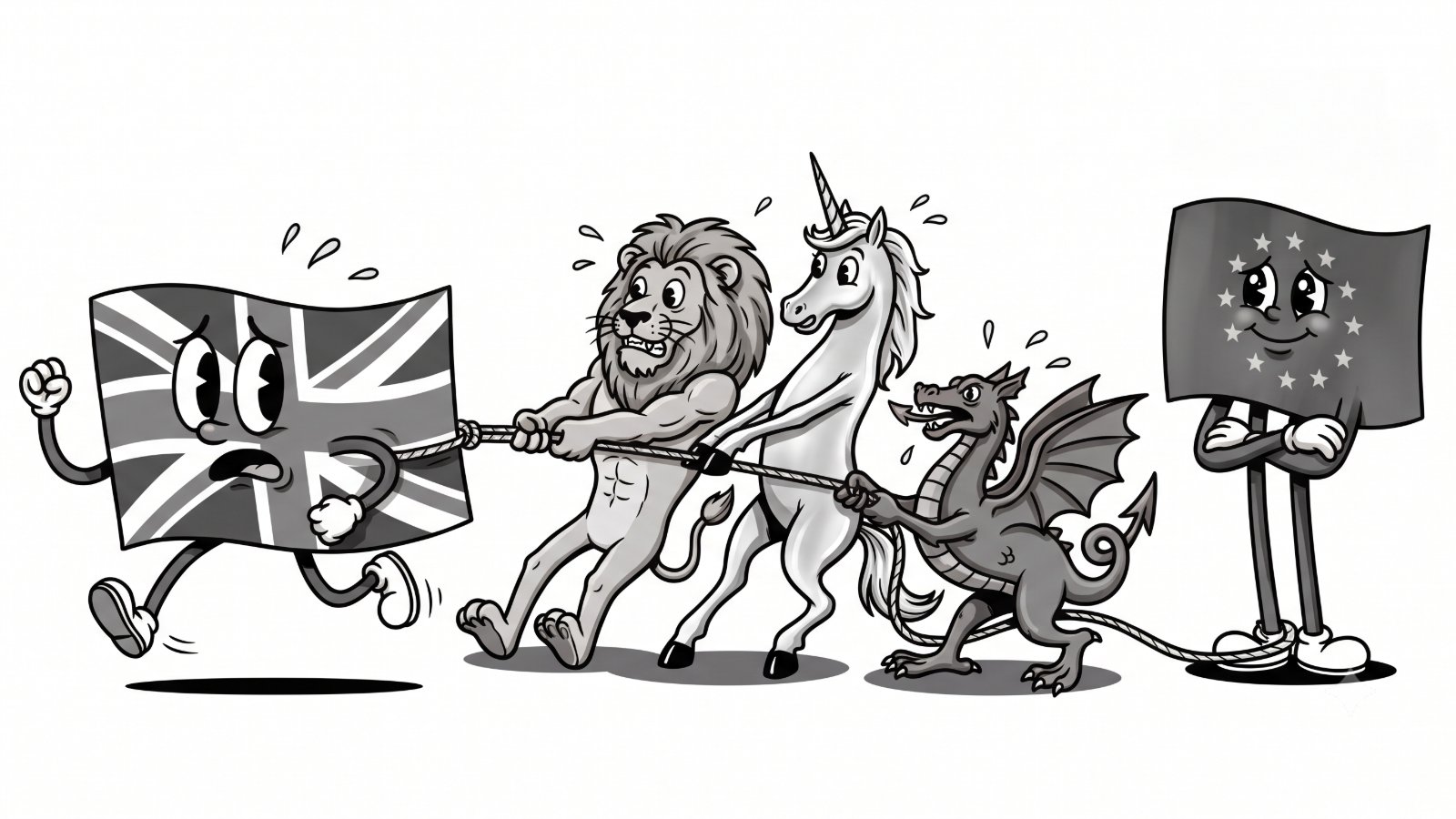
Ten years after the fateful referendum of June 2016, the debate over the United Kingdom's European future is no longer a matter of mere speculation among theorists. As the structural costs of Brexit have permanently settled and global geopolitical balances increasingly demand highly integrated continental blocs, the question of rejoining has emerged with renewed force.
London's return to the European project must not be envisioned as a mere transactional fix. Viewed through the prism of European federalism, this return is a mutual necessity to overcome the inefficiency of fragmented sovereignties and to consolidate our continent's strategic autonomy. Nevertheless, this path toward unification faces complex electoral dynamics, as illustrated by the political earthquake of May 2026.
Contents
1. The Economic Anatomy of a Decade of Isolation
The promises of a Global Britain freed from Brussels' constraints have shattered against the wall of macroeconomic realities. Data accumulated up to 2026 demonstrates that the cost of Brexit was not a temporary shock, but a permanent structural amputation.
According to a synthesis analysis published on VoxEU/CEPR by economists from the Centre for Economic Performance and UK in a Changing Europe, the UK's GDP per capita is 6% to 8% lower than it would have been had the country remained in the EU1. The British Office for Budget Responsibility2 confirms for its part that the Trade and Cooperation Agreement reduces long-term British productivity by 4% compared to the status quo of membership, with a projected 15% drop in total import and export volumes2.
vs EU counterfactual −6/8% Cumulative loss, 2016-2025 decade ↓ Permanent
vs OECD trajectory −12/18% Business investment deficit ↓ Structural
TCA vs EU membership −4% Long-term loss (OBR, 2025) ↓ Long-term
imports + exports −15% Projected volume vs status quo (OBR) ↓ OBR Projection
This economic drift translates into a growing divergence with our European partners. According to OECD data for Q1 2026, Eurozone GDP stands at 7.0% above its pre-pandemic 2019 level, whereas the UK stagnates at +6.0%. Even more telling, business investment lags 12% to 18% behind the trajectories of comparable OECD economies, while the overall employment level records a 3% to 4% deficit, weighted down by administrative barriers to free movement13.
Figure 1. Post-Covid Recovery Divergence: Real GDP as % of Q4 2019 Level, G7 and Eurozone (Q4 2019 = 100)
Sources: OECD Data Explorer, Quarterly GDP level of G7 and Eurozone; House of Commons Library (2026). France/Germany data for recent quarters are interpolated estimates based on OECD trends.
In light of these numbers, the conclusion is clear: absolute economic sovereignty is a chimera in a globalized market. The United Kingdom's return to the Single Market and Customs Union represents the most direct lever to restore productivity and halt relative decline.
2. The Federalist Lens: Moving Beyond the Transactional Model
We refuse to evaluate the UK's return solely through the lens of a balance-sheet cost-benefit calculation. European federalism offers a far richer analytical framework: that of co-sovereignty and collective power.
From the perspective of federalist theory, Brexit was the ultimate manifestation of the Westphalian illusion—the obsolete idea that the nation-state can single-handedly address transnational challenges. Whether regulating digital giants, driving the climate transition, or securing continental defense against resurgent imperialisms, the national scale has become ineffective.
The Illusion of Alignment Without Voice
By remaining outside the institutions, the UK is condemned to the worst possible scenario for a major power: taking European rules without having any say in shaping them. Prime Minister Keir Starmer has repeatedly called for closer economic integration, notably at the Munich Security Conference4. But this incremental policy hits an insurmountable federal boundary: the Union cannot accept cherry-picking. A partial return or passive alignment would turn the UK into a satellite state—a democratic anomaly for the land of the Magna Carta.
A Federalism of Geography and Defense
A British return would redefine European defense architecture. Integrating the continent's leading military power alongside France would finally give federal substance to Europe's strategic autonomy. For the European bloc, reintegrating London means permanently anchoring the pan-European dimension of the project and streamlining the governance of continental public goods: security, energy, and research.
3. The May 2026 Earthquake: Reform UK's Populist Surge
Any analysis of the British trajectory cannot ignore the electoral upheaval of May 7, 2026. Led by Nigel Farage, Reform UK achieved an historic breakthrough in the English local elections, winning 1,451 council seats (41% of all contested seats) and taking control of 14 county councils across England, including Suffolk, Norfolk, Essex, and Lancashire, seized from the Conservatives. Labour, on its end, lost 1,496 council seats, marking its worst local election results on record56. Simultaneously, in the Welsh Senedd elections, Reform UK secured 34 seats, becoming the second-largest political force in the Cardiff Parliament.
Figure 2. English Local Elections, May 7, 2026: Elected Councillors (Wide Bar) and Signed Net Change (Thin Bar, Right Axis)
Sources: NFU External Affairs (2026); Institute for Government (2026); LGC live blog (2026). Elected councillors totals: consolidated estimates across 134-136 English councils. Net changes: Reform +1,451, Lib Dems approx. +400, Greens +287, Conservatives −500, Labour −1,496. Methodological differences between BBC (2022 baseline) and Press Association (pre-election standing) account for discrepancies in published net changes.
Significance for the European Project: The Paradox of Polarization
Through a federalist lens, Reform UK's triumph carries a dual significance:
- A Rigid Nationalist Bribe: It confirms that a substantial portion of the British electorate, concentrated in deindustrialized regions, remains fiercely attached to the rhetoric of insular sovereignty. A Rejoin process will not be smooth sailing, but an intense cultural battle.
- The Destruction of Two-Party Politics: By drawing votes almost equally from Conservatives and Labour, Reform UK forces Keir Starmer into extreme caution, blocking any attempt at an official short-term rapprochement with Brussels. Holding 27.3% of national voting intentions as of May 27, 2026, Reform UK now stands as the country's leading political force7.
4. Civil Society Mobilizes: The Rise of Pro-EU Movements
In response to Reform UK's electoral surge, a deep counter-movement has been building for several years within British civil society. Far from being confined to nostalgic London intellectual circles, the pro-European movement has structured itself into a mass network of organizations whose voices are now echoing inside parliamentary debates.
European Movement UK: Grassroots Advocacy Power
Founded in 1948 in the wake of the Hague Congress, European Movement UK is today the largest grassroots pro-European organization in the United Kingdom, boasting 27,340 active members and over 100 local groups across the nation8. Its declared goal is explicit: reverse the effects of Brexit, restore freedom of movement, and protect European opportunities for British youth, notably through a return to the Erasmus+ program. The organization regularly hosts public events, conferences, and activist meetings from Westminster to Edinburgh, and has influenced several parliamentary debates regarding reintegration into European energy markets and mutual recognition agreements.
National Rejoin March and Best for Britain: Street Activism and Lobbying
Alongside grassroots movements, two other structures have played a growing role. The National Rejoin March (NRM), founded by Peter Corr, has organized annual marches in London since 2022 to keep Rejoin on the political agenda. The third edition, in September 2024, was described by organizers as its most successful yet. Best for Britain, established in 2017 by Gina Miller, has transformed since 2021 into a strategic lobbying organization focused on strengthening UK-EU ties in the short term while keeping long-term re-accession open9.
Young European Movement UK: Generational Legacy
As the youth wing of European Movement UK and the British section of the Young European Federalists (JEF), the Young European Movement UK (YEM) embodies the generational dimension of pro-European activism. It spearheaded the Embrace Erasmus petition, gathering over 41,000 signatures. Its president, Alfred Quantrill, spoke publicly at the first EU-UK Summit on May 19, 2025, advocating for a Youth Experience Scheme to allow young Britons access to mobility in education, training, and employment10. This network maintains direct ties with PromethEUs and other European federalist think tanks.
Rejoin EU Party: Niche Party and Electoral System Barriers
Alongside these civil society organizations, the Rejoin EU Party deserves mention as a registered UK political party focused entirely on a single objective: full reintegration into the European Union. Founded and chaired by Brendan Donnelly, a former Conservative MEP who resigned in protest over his party's anti-European shift, the party promotes a clear manifesto: constitutional reform introducing proportional representation, immediate restoration of free movement, suspension of regulatory divergence from the EU, and ultimate adoption of the euro11.
However, attributing significant electoral weight to it would be inaccurate. Despite fielding 26 candidates in the 2024 general election, the party won only 9,245 votes in total, with all candidates losing their deposits. In the Gorton and Denton by-election in February 2026, its candidate secured barely 98 votes (0.3%). In the May 2026 local elections, its participation remained negligible12. This electoral marginality is not unique to this party: it reflects a structural constraint of the British first-past-the-post voting system, which mechanically disadvantages parties with geographically dispersed support.
Since 2024-2025, the UK has been transitioning from traditional two-party dominance toward unstable multi-party politics, highlighted by Reform UK's rise. Yet this fragmentation primarily benefits forces with concentrated geographical strongholds—something the Rejoin EU Party, spread thinly across the territory, is structurally unable to leverage. Its role functions more as an indicator of public opinion and a pressure group on major parties than as a parliamentary force. In this sense, it embodies the central paradox of the UK pro-European movement: a majority in public opinion (63%) lacking direct electoral translation due to an unfavorable representative system.
Breaking the Political Taboo: Wes Streeting Shatters the Consensus
The defining shift in 2026 is that this debate has moved beyond civil society to enter the corridors of power. Wes Streeting, former Health Secretary and influential Labour figure, bluntly stated that Brexit was a catastrophic mistake and that Britain should one day rejoin the European Union13. His position immediately reignited debate within Labour, forcing Prime Minister Starmer to clarify his red lines. This shift in rhetoric from activist margins to the heart of the Labour Party represents a qualitative turning point that federalist observers cannot ignore.
“Leaving the European Union was a catastrophic mistake. It left us poorer, less powerful, and less in control of our destiny. We must remake the argument. Britain's future lies in Europe, and one day, inside the European Union.”
Source: Wes Streeting, former Health Secretary, May 2026 (TIME, 2026)
This shift in discourse is not isolated: it forms part of a broader momentum in which a parliamentary petition to rejoin the EU surpassed 10,000 signatures, legally requiring a formal government response14.
Institutional Catch-Up: Stocktaking the 2025-2026 Agreements
Shifting rhetoric would remain mere exercise in style without concrete diplomatic movement. The EU-UK Summit on May 19, 2025—the first since the UK's departure—produced a framework document, the Common Understanding, outlining a roadmap for sectoral alignment without dismantling the core Brexit structure13. This progress stocktaking should be assessed objectively, avoiding both ungrounded optimism and blanket skepticism: while certain initiatives succeeded, others remain stalled.
(Agri-food) Under Negotiation Dynamic alignment proposed, CJEU final authority Mandate adopted, July 2025
(ETS) Under Negotiation Same dynamic alignment logic Mandate adopted, July 2025
(Youth Mobility) Under Negotiation Numerical cap and visa duration to be decided Mandate adopted, June 2025
(€150bn) Failed Disagreement over British financial contribution Talks broke down, November 2025
UK - Ireland Concluded Subsea cables, cyberdefense, maritime surveillance Cork Summit, March 2026
Two major cases highlight the difficulty of reaching compromise. On one hand, talks regarding British participation in the European defense fund SAFE broke down in November 2025, as London refused to pay the entry fee demanded by Brussels in exchange for raising industrial participation caps to 50%14. This setback—on an issue where federalists expected a dramatic demonstration of reunited European defense—serves as a reminder that a specialized partnership cannot replace membership: outside the decision-making table, the UK must negotiate every mechanism item by item without the voting rights that come with full membership. On the other hand, the agreement associate the UK with the Erasmus+ program was finalized in December 2025, enabling British students to study in Europe without differential tuition fees starting January 2027—a quarter-century after Boris Johnson's 2020 withdrawal10.
The Irish dimension warrants special consideration, extending beyond the strict EU-UK framework into bilateral neighborhood relations. Meeting in Cork in March 2026 for the second British-Irish Leaders' Summit, Keir Starmer and Taoiseach Micheál Martin signed a refreshed Memorandum of Understanding on defense cooperation—updating the 2015 accord to cover maritime surveillance and cyberdefense15. More significantly for geopolitical analysis, both nations established a new bilateral framework for subsea infrastructure protection, planning a joint exercise for September 2026. Furthermore, Ireland formally requested to join the North Sea Joint Declaration alongside the UK, Norway, Belgium, the Netherlands, and Germany15. This convergence on subsea cable security, outside any formal EU framework, illustrates a broader trend: as hybrid threats intensify, London and Dublin are rebuilding piece by piece outside Union structures the very coordination that common membership would have rendered automatic.
Sources: House of Commons Library, UK-EU Summit - Common Understanding (2025, 2026); House of Lords European Affairs Committee, Unfinished Business: Resetting the UK-EU relationship (2026); Associated Press (Nov. 2025, Dec. 2025); UK in a Changing Europe (2026); Statement between Prime Minister Keir Starmer and Taoiseach Micheál Martin, gov.ie (March 2026).
5. The Tangible Cost of Brexit: Businesses, Borders, and the Migration Control Paradox
The macroeconomic aggregates in Chapter 1 tell a story of relative decline. But to convince a British electorate burned by years of unfulfilled promises, the federalist argument must descend to where Brexit is experienced daily: the counter of a small business exporting to France, the customs form of an artisan, and the issue that carried the most weight in the 2016 vote—immigration control.
The Administrative Burden on SMEs: Red Tape as an Invisible Border
Following the effective departure from the single market, the British government itself anticipated an additional burden of 215 million customs declarations per year at an estimated cost of £7 billion, justifying the recruitment of 50,000 new customs officers16. Five years later, this forecast has been broadly confirmed by businesses' lived experience. According to quarterly British Chambers of Commerce surveys conducted in 2025, customs procedures remain the primary barrier cited by exporting companies (45%), followed by export documentation (39%)20. By May 2026, 34% of small exporters reported compliance cost increases exceeding £5,000 annually, with an equal proportion considering halting EU sales altogether if trends persist21. UK agri-food exports to the EU—a sector where rules of origin, sanitary/phytosanitary certificates, and VAT registration across member states compound—have plummeted 34% since Brexit21.
This burden is no minor technical nuisance: it imposes a structurally heavier weight on smaller firms than on multinationals equipped with dedicated compliance departments. A French SME selling to Germany completes a single delivery note. Its British counterpart must navigate EORI numbers, preferential rules of origin, potential health certificates, and, for intra-EU triangular sales, destination-country VAT registration. This is precisely the fixed cost European federalism eliminates by replacing twenty-seven regulatory borders with a single trading zone.
The Structural Cost of Trade Beyond Tariffs
It is often repeated that the Trade and Cooperation Agreement preserved free trade by maintaining zero tariffs on most goods of British origin. While true, this is misleading: the bulk of Brexit's trade costs stems not from tariffs, but non-tariff barriers—sanitary checks, rules of origin paperwork, dual certifications, and port delays—which act as hidden tariffs. This is reflected in the OBR's projected 15% drop in total trade volume noted in Chapter 1, and verified by observed drops of 20% to 42% across specific goods categories22. Compounding this since 2026 is the phased rollout of the EU's Carbon Border Adjustment Mechanism, which will penalize British industrial exporters until a carbon market linkage agreement is signed.
The Migration Control Paradox: 2016 Promises vs Reality
Here lies the most counterintuitive—and compelling—argument for reintegration: the central promise of the 2015-2016 Leave campaign to "take back control" of borders and reduce immigration has simply failed in practice, even if achieved strictly on paper.
Final pre-referendum year 333,000 Total net migration. EU: 184,000 · Non-EU: 188,000, near parity
Post-Brexit Peak 606,000 All-time high, driven by 925,000 non-EU arrivals vs 151,000 EU ↑ +82% vs 2015
Latest Available Data 171,000 EU: -42,000 (net loss) · Non-EU: +350,000 · British: -136,000 ↓ -49% vs 2015
Sources: Migration Observatory, University of Oxford (2016, 2026); Office for National Statistics, Long-term international migration (2023, 2026); TwentyFour Asset Management (2026).
Three conclusions emerge from this timeline. First, contrary to Leave campaign narratives, EU migration in 2015 accounted for barely half of total immigration, standing at parity with non-EU arrivals23. Second, ending free movement did not reduce net migration—it caused it to surge: in 2022 and 2023, the UK experienced the highest net migration levels in its history, driven entirely by non-EU work, study, and humanitarian arrivals (Ukraine, Hong Kong) that the UK government was legally free to admit without EU constraints24. Third, the decline observed since 2024 results not from Brexit itself, but from subsequent domestic administrative tightening—restrictions on care worker dependents, student family visas, and stricter asylum rules—policies the UK could have implemented as an EU member, given that EU frameworks never governed non-EU migration to member states25.
The most striking result remains this: in 2025, for the first time since the ONS began tracking these statistics, net migration from the EU turned negative—more European citizens left the UK than arrived—while non-EU net migration remains structurally higher than before the referendum25. The UK obtained, at high cost, the legal capacity to choose who enters its territory—an undeniable fact. However, it failed to deliver the numerical reduction promised by the 2016 campaign. For federalists, the lesson is clear: formal sovereignty and effective control of flows are distinct, and the UK paid a heavy economic price for the former without achieving the latter. Furthermore, rejoining the EU would restore free movement only for Europeans—the exact demographic that, contrary to 2016 narratives, was never the primary driver of broader public concerns over immigration levels.
Transposition Without Voting: The Sovereignty Price of Partial Rapprochement
The final paradox is perhaps the most revealing for a federalist audience. To minimize trade friction, the SPS agreement currently under negotiation between London and Brussels relies on dynamic alignment: the UK commits to automatically transposing future updates to EU sanitary and phytosanitary rules into domestic law, or face losing agreement benefits26. The UK will hold no Council vote nor European Parliament seats to shape these rules; it can at best participate in informal consultations prior to decisions, while paying a financial contribution for the privilege. In case of disputes over EU law interpretation, the Court of Justice of the European Union will serve as the ultimate arbiter—a role the UK government explicitly accepted in the May 2025 summit framework26.
Better than any theoretical argument, this situation highlights the thesis outlined in Chapter 2: outside the Union, the UK does not regain the regulatory sovereignty promised by Brexit; it trades it for market access, losing the very thing that made submission to EU standards legitimate under full membership—the ability to negotiate and vote on them. Across aligned sectors, the country becomes a rule-taker in the strictest sense, lacking a seat at the table where rules are written. Paradoxically, the more the UK deepens sectoral agreements with the EU to mitigate Brexit's economic damage, the closer it gets functionally to a member state status without any of the accompanying benefits: votes, rotating presidencies, structural funds, or a voice in the European Council. Full reintegration is therefore not only the most economically advantageous route; it is also the only path that restores consistency between the obligation to comply with European law and the democratic right to decide it.
6. Sociological Evolution: A Country Divided by Age and Demographics
How can Nigel Farage's electoral surge be reconciled with a majority desiring to rejoin the EU? The answer lies in a sharp generational polarization, highlighted with unprecedented clarity by spring 2026 data.
A YouGov poll from May 20-22, 2026, provides a detailed mapping of public opinion across four future EU relationship scenarios, broken down by voter group16. The resulting picture is remarkably clear: 56% of Britons support full EU reintegration (versus 35% opposed), and 70% support a closer relationship short of formal membership, including 61% of former Leave voters and 49% of Reform UK voters. Conversely, only 31% wish to maintain the status quo, and just 19% favor further distancing17.
Figure 3. What Forms of EU Relationship Would Britons Support? (% Support / Oppose by Voting Group, YouGov, May 20-22, 2026)
Rejoin the European Union
Closer Relationship Without Rejoining (Neither Single Market Nor Customs Union)
Maintain the Current Relationship As Is
Further Distance Ties with the EU
Source: YouGov (2026a), survey conducted May 20-22, 2026. Voting groups: 2016 referendum voters (Remain/Leave) and 2024 general election voters (Greens, Labour, Lib Dems, Conservatives, Reform UK). Faithful reproduction of published YouGov data. Remaining percentage to reach 100% accounts for undecideds ("don't know").
A separate YouGov poll from April 2026 showed 63% of Britons supporting full reintegration18. The slight variation from the 56% May tracker reflects standard polling wording volatility, but the underlying trend is undeniable: support for Rejoin holds a clear majority and has strengthened significantly since 2016 (52% Leave).
The Generational Divide: The Scissors Effect
Polling reveals a striking generational divide:
- 16-24 year-olds: 83% to 86% would vote to Rejoin184. For this demographic, Brexit represents a direct constraint on freedom of movement and economic opportunity.
- Retirees: 60% now support Rejoin15—a dramatic shift overturning the notion of a monolithically Eurosceptic 65+ voting bloc.
- Reform UK and Protest Voters: Reform UK support concentrates among voters aged 45+ in deindustrialized regions, reflecting identity-based frustration rather than doctrinal adherence to Brexit. Notably, May 2026 YouGov data reveals that 49% of Reform voters support a closer EU relationship short of formal re-entry, demonstrating that hard Euroscepticism is not absolute even within this base.
Figure 4. UK Public Opinion Trajectory on EU Membership (June 2016 - April 2026): % "Remain/Rejoin" vs % "Leave/Stay Out"
Sources: YouGov tracker (2016-2026a); Brexit FactBase (2026). Data for intermediate periods (2017-2025) are interpolated based on aggregated YouGov tracker trends.
Figure 5. Generational Divide: Support for Rejoin vs Staying Out, by Age Group (April-May 2026, %)
Sources: YouGov (2026a); ITV News (2026); London Economic (2026). Note: 25-34, 35-54, and 55-64 age brackets are interpolated from YouGov tracker and ITV data. The 65+ bracket incorporates April 2026 YouGov survey data (60% Rejoin among retirees).
Reform UK's rise serves as a stark reality check in national debate. While a majority of Britons favor rejoining or aligning closer with the EU, Reform UK's 27.3% national polling share7 underscores the split between a growing pro-European demographic majority and a politically hyper-active minority driven by deindustrialization and identity grievances.
Conclusion: The Conditions for an Historic Return
The road back will require realism on both sides of the Channel. The UK cannot return demanding the opt-outs of the past—budget rebates, exemptions from Schengen, or opt-outs from Economic and Monetary Union—as European public opinion and Union rules demand a clear commitment to the common project.
What 2026 data demonstrates is the emergence of a pro-European ecosystem in the UK that did not exist during the 2016 referendum: 63% public support for return, structured civil movements with tens of thousands of members, and leading political figures openly acknowledging the error. The question is no longer if the UK will return, but when and under what conditions.
The timeline for re-entry remains open, but key parameters are defined. Demographically, generational replacement moves mechanically in favor of Rejoin: highly europhile cohorts reach voting age each year while older Eurosceptic demographics contract—a shift that within a decade could independently tip parliamentary majorities. Strategically, the failure of SAFE defense fund negotiations in November 2025 illustrates the cost of half-measures: staying outside forces the UK to negotiate every layer of European cooperation at high cost without guaranteed success, whereas full membership offers a permanent seat at the table shaping continental security policy against Russian threats. The most likely path forward is not a single leap into full membership, but a progressive deepening—rejoining the Single Market, entering a Customs Union, and eventually political re-accession—with each step highlighting that the cost of remaining outside permanently exceeds the cost of return.
The UK's return to the EU is not a backward step of nostalgia: it is a forward step toward unifying a continent that can no longer afford division. By taking its place back at the Council table, the UK would regain its historic power projection, while the European Union furthers its federal mission: becoming a global power encompassing all of Europe.
References
- Springford (ed.) (2025) Brexit's slow-burn hit to the UK economy, VoxEU/CEPR. Available at: https://cepr.org/voxeu/columns/brexits-slow-burn-hit-uk-economy (Accessed 02/08/2026).
- Office for Budget Responsibility (OBR) (ed.) (2025) Brexit analysis: Economic and fiscal outlook. Available at: https://obr.uk/forecasts-in-depth/the-economy-forecast/brexit-analysis/ (Accessed 02/08/2026).
- House of Commons Library (ed.) (2026) GDP international comparisons: Economic indicators. Available at: https://commonslibrary.parliament.uk/research-briefings/sn02784/ (Accessed 02/08/2026).
- ITV News (ed.) (2026) Over 80% of 16 to 24-year-olds would vote to rejoin the EU, ITV poll finds. Available at: https://www.itv.com/news/2026-02-19/over-80-of-16-to-24-year-olds-would-vote-to-rejoin-the-eu-itv-poll-finds (Accessed 02/08/2026).
- House of Commons Library (ed.) (2026) Local Elections 2026: results and analysis, CBP-10272. Available at: https://commonslibrary.parliament.uk/research-briefings/cbp-10272/ (Accessed 02/08/2026).
- NFU External Affairs (ed.) (2026) NFU External Affairs team analyses what the 2026 election results mean for farming. Available at: https://www.nfuonline.com/news/may-2026-local-election-results/ (Accessed 02/08/2026).
- PollCheck (ed.) (2026) Latest UK Opinion Polls Today — Voting Intention Tracker. Available at: https://www.pollcheck.co.uk/gb-polls (Accessed 02/08/2026).
- European Movement UK (ed.) (2026) Join our movement of 27,340 members. Available at: https://www.europeanmovement.co.uk/membership (Accessed 02/08/2026).
- Best for Britain (ed.) (2026) About Best for Britain. Available at: https://www.bestforbritain.org (Accessed 02/08/2026).
- Young European Movement UK (YEM) (ed.) (2025) YEM President calls for Youth Experience Scheme at EU-UK Summit, 19 mai 2025. Available at: https://www.yem.org.uk (Accessed 02/08/2026).
- Rejoin EU Party (ed.) (2024) Manifesto 2024. Available at: https://therejoineuparty.com/manifesto-2024/ (Accessed 02/08/2026).
- Rejoin EU (ed.) (2026) Rejoin EU — Wikipedia. Available at: https://en.wikipedia.org/wiki/Rejoin_EU (Accessed 02/08/2026).
- TIME (ed.) (2026) Could the United Kingdom Rejoin the E.U.? Here's Everything You Need to Know. Available at: https://time.com/article/2026/05/18/united-kingdom-rejoins-eu-possibility-starmer-streeting-debate/ (Accessed 02/08/2026).
- UK Parliament Petitions (ed.) (2026) Apply to Rejoin the EU as soon as possible to increase growth in the UK. Available at: https://petition.parliament.uk/petitions/749128 (Accessed 02/08/2026).
- YouGov (ed.) (2025) Nine years after the EU referendum, where does public opinion stand on Brexit?. Available at: https://yougov.com/en-gb/articles/52410-nine-years-after-the-eu-referendum-where-does-public-opinion-stand-on-brexit (Accessed 02/08/2026).
- YouGov (ed.) (2026) How strong is UK support for rejoining the European Union?. Available at: https://yougov.com/en-gb/articles/54567-how-strong-is-uk-support-for-rejoining-the-european-union (Accessed 02/08/2026).
- Brexit FactBase (ed.) (2026) Attitudes to rejoining the EU. Available at: https://brexitfactbase.com/17-opinions-of-brexit/current-attitudes-to-rejoining/ (Accessed 02/08/2026).
- London Economic (ed.) (2026) Brits would overwhelmingly back Rejoin in new referendum. Available at: https://www.thelondoneconomic.com/politics/brits-would-overwhelmingly-back-rejoin-in-new-referendum-2-404739/ (Accessed 02/08/2026).
- Rejoin EU Party (ed.) (2026) Team. Available at: https://therejoineuparty.com/team/ (Accessed 02/08/2026).
No comments yet.