Nädala uudised

Meie sotsiaalmeedia postitused, siin nii, nagu need avaldati: päeva Euro Daily Flash ja nädala karussell, mida lehitseda, meeldivaks märkida ja kommenteerida.

prometheus.fr Euro Daily Flash · Versioon: English
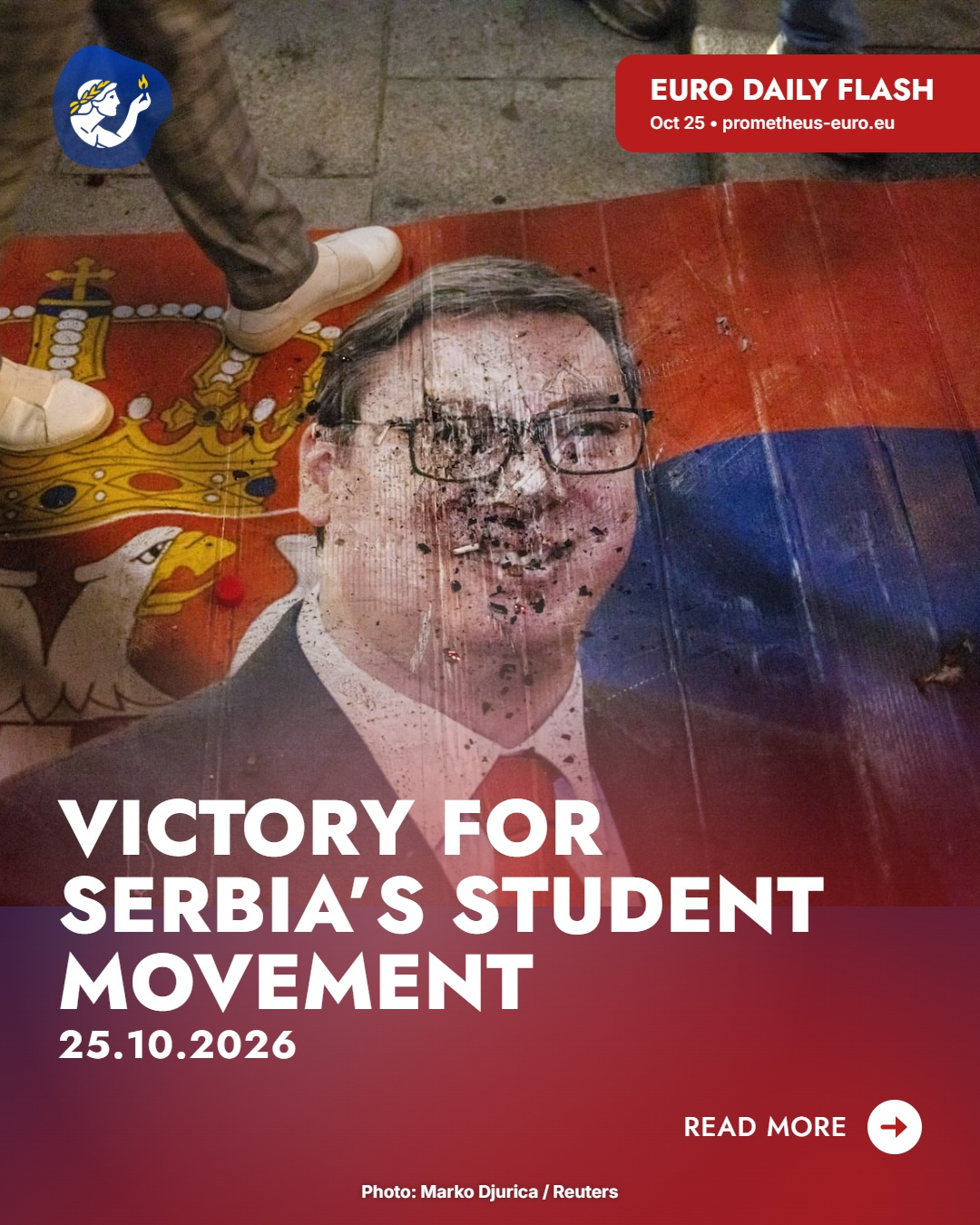
Euro Daily Flash — 26 oktoober 2026 : Victory for Serbia’s student movement
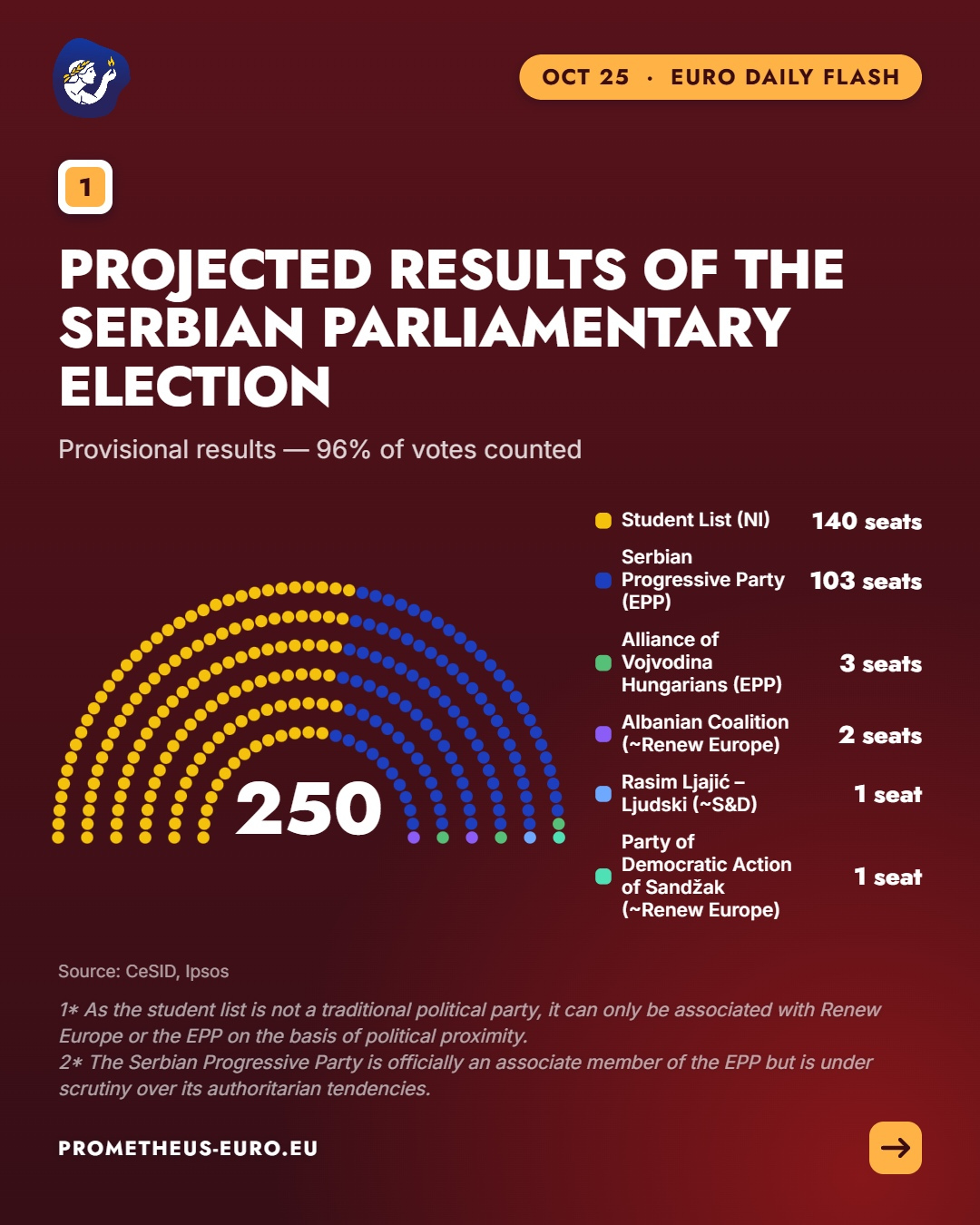
Projected results of the Serbian parliamentary election. Provisional results — 96% of votes counted
PromethEUs — jälgi Euroopa uudiseid Instagramis ja LinkedInis

Ole esimene, kellele see meeldib

Euroopa uudised, 26 oktoober 2026 — Victory for Serbia’s student movement

prometheus.fr 🇷🇸 SERBIA: STUDENT MOVEMENT WINS PARLIAMENTARY ELECTION

Serbia is entering a new political era. After nearly two years of protests against corruption and abuses of power, the student list has emerged ahead of Aleksandar Vučić’s coalition, which has been in power for fourteen years.

🔎 WHAT THE LATEST PROJECTIONS SHOW

▪️ Student List: 140 seats
▪️ “Aleksandar Vučić – United Serbia” coalition: 103 seats
▪️ National minority lists: 7 seats in total

⚠️ PROJECTIONS REMAIN PROVISIONAL

Based on 96% of the sample processed by CeSID and Ipsos, these projections give the student list an absolute majority in Serbia’s 250-seat parliament. The final results remain to be confirmed.

🇪🇺 A TURNING POINT FOR EUROPE

This victory opens a new chapter in Serbian politics and raises a major question: will it strengthen the rule of law, the fight against corruption and Serbia’s rapprochement with the European Union?

📲 Swipe to explore the election projections.

PromethEUs | Making sense of European affairs

#Serbia #Europe #EuropeanUnion #Democracy #Elections #EuroDailyFlash #PromethEUs

Sources
2. CeSID, Ipsos

Loe seda karusselli tekstina
  1. Victory for Serbia’s student movement

  2. Projected results of the Serbian parliamentary election

    Provisional results — 96% of votes counted

    Allikas : CeSID, Ipsos

prometheus.fr Nädala uudised · Versioon: English
Nädala uudised — 19 – 25 okt 2026 : Exchange of 270 prisoners from each side between Kyiv and Moscow ; Musk admits to restricting Starlink ; Another week of protest across Europe ; MEPs Call for the Houthis to be added to the Terrorist List
Ukraine - Russia — Exchange of 270 prisoners from each side between Kyiv and Moscow. Russia and Ukraine exchanged 270 people each following discussions with U.S. negotiators earlier this week. Among those returned to Ukraine are nine civilians, as…
Technology — Musk admits to restricting Starlink. Elon Musk stated on Saturday that SpaceX had restricted Starlink service in Ukraine, just as Kyiv reported that connection issues appeared to have been resolved. He accused the Ukrainian military of…
Society — Another week of protest across Europe. Once again this week, protests took place in cities across the Continent, from France to Albania, Italy, Spain, and Portugal. Pensions, housing, education, corruption, and opposition to war: the…
Middle east — MEPs Call for the Houthis to be added to the Terrorist List. On Thursday, the European Parliament approved a non-binding resolution calling for the Houthis to be added to the EU’s list of terrorist organizations and for all their…
International prize — The Sakharov Prize Awarded to the International Criminal Court. On Thursday, October 22, the European Parliament awarded the Sakharov Prize for Freedom of Thought to the International Criminal Court (ICC) and its staff. This…
International — A new strategy for the Arctic. The European Commission has unveiled a new strategy for the Arctic, which it considers its “northern neighborhood.” The plan is based on four priorities: security, climate, the economy, and the people…
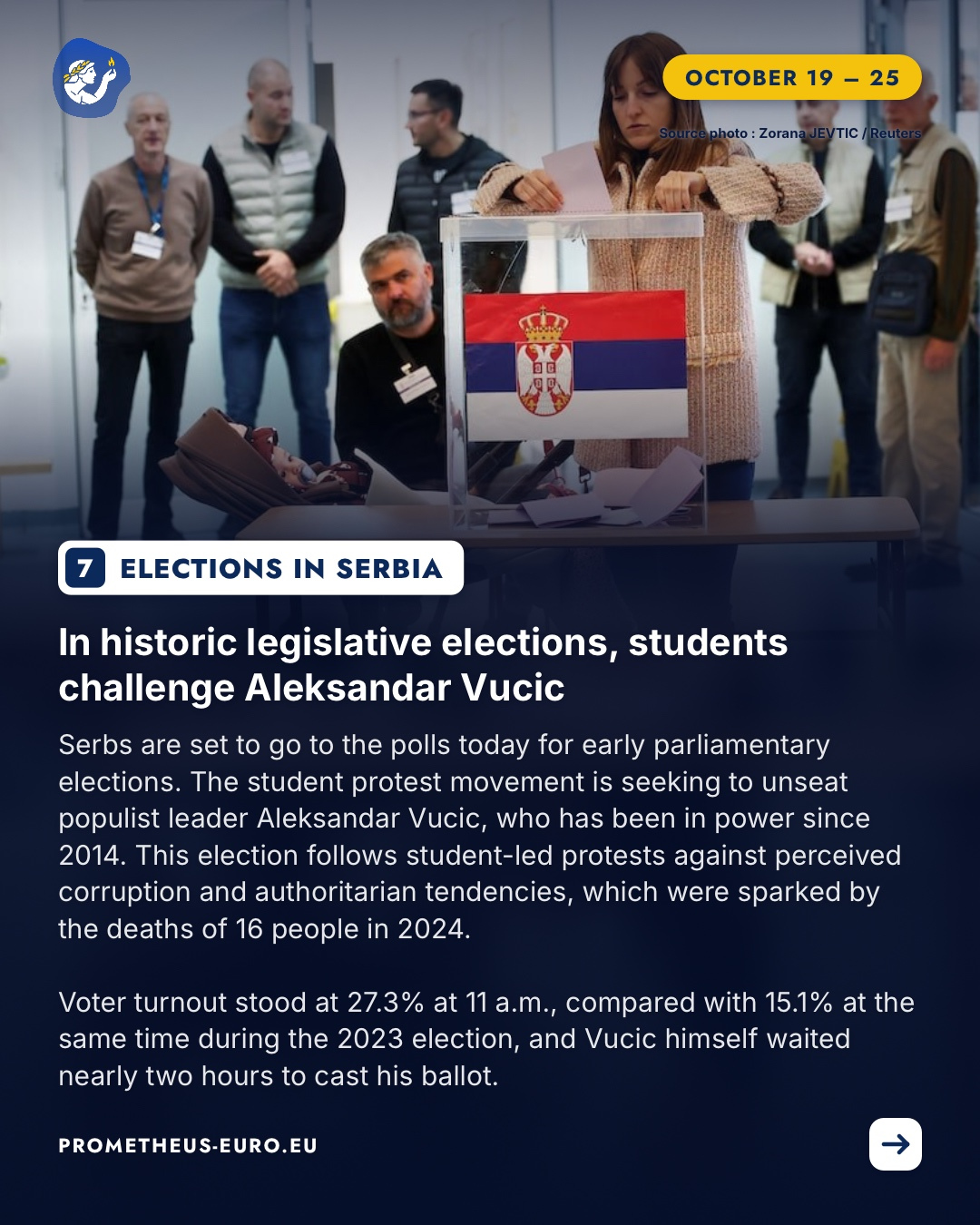
Elections in Serbia — In historic legislative elections, students challenge Aleksandar Vucic. Serbs are set to go to the polls today for early parliamentary elections. The student protest movement is seeking to unseat populist leader Aleksandar…
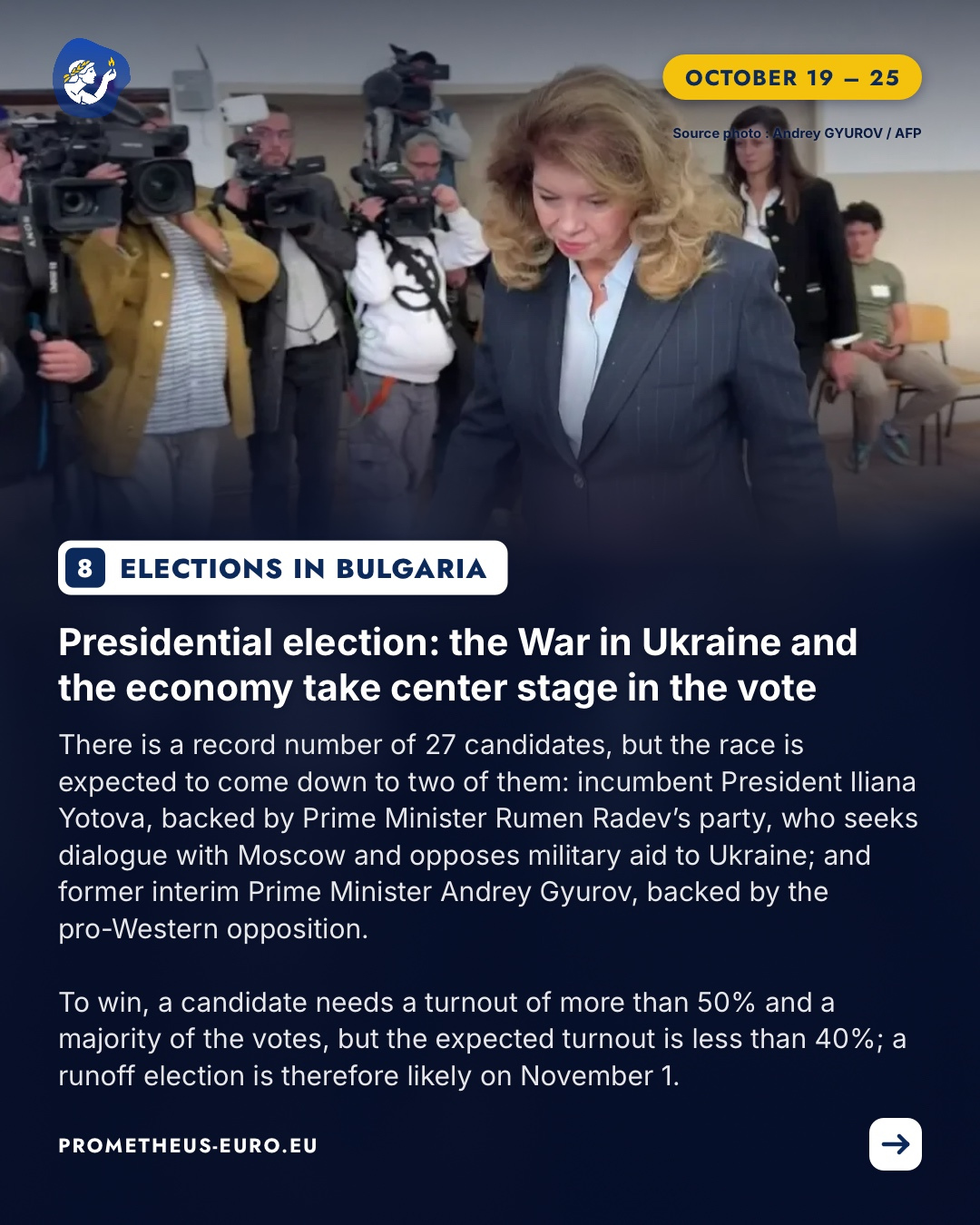
Elections in Bulgaria — Presidential election: the War in Ukraine and the economy take center stage in the vote. There is a record number of 27 candidates, but the race is expected to come down to two of them: incumbent President Iliana Yotova…
PromethEUs — jälgi Euroopa uudiseid Instagramis ja LinkedInis

Ole esimene, kellele see meeldib

Nädala Euroopa uudised, 19 – 25 okt 2026 — Exchange of 270 prisoners from each side between Kyiv and Moscow

prometheus.fr 🇪🇺 EUROPE | 8 key European stories from the Week of October 19–25.

🛡️ Security and Defense: In Ukraine, Kyiv and Moscow exchanged 270 prisoners each. Elon Musk confirmed that he had restricted Starlink service in Ukraine, though the service has since been restored. In the Middle East, the European Parliament called for the Houthis to be added to the EU’s terrorist list.

🌍 Foreign Relations: The Sakharov Prize is awarded to the International Criminal Court, despite US sanctions against the Court. Meanwhile, the EU unveils its new Arctic strategy.

🗳️ Elections: In Serbia, historic parliamentary elections see students challenging Aleksandar Vucic. In Bulgaria, the presidential election, centered on the war in Ukraine and the economy, is expected to be decided in the second round.

📢 Society: In France, Albania, Italy, Spain, and Portugal, protests are taking place, focusing in particular on the high cost of living, pensions, housing, and corruption.

📲 Discover the key facts and implications of these eight stories in this carousel.

PromethEUs | Making sense of European affairs.

Sources
1. Reuters
2. BBC
3. Euronews
4. Euronews
5. Le Monde
6. Commission européenne
7. Reuters
8. Euronews

Loe seda karusselli tekstina
  1. European news of the week

    Find our articles on prometheus-euro.eu

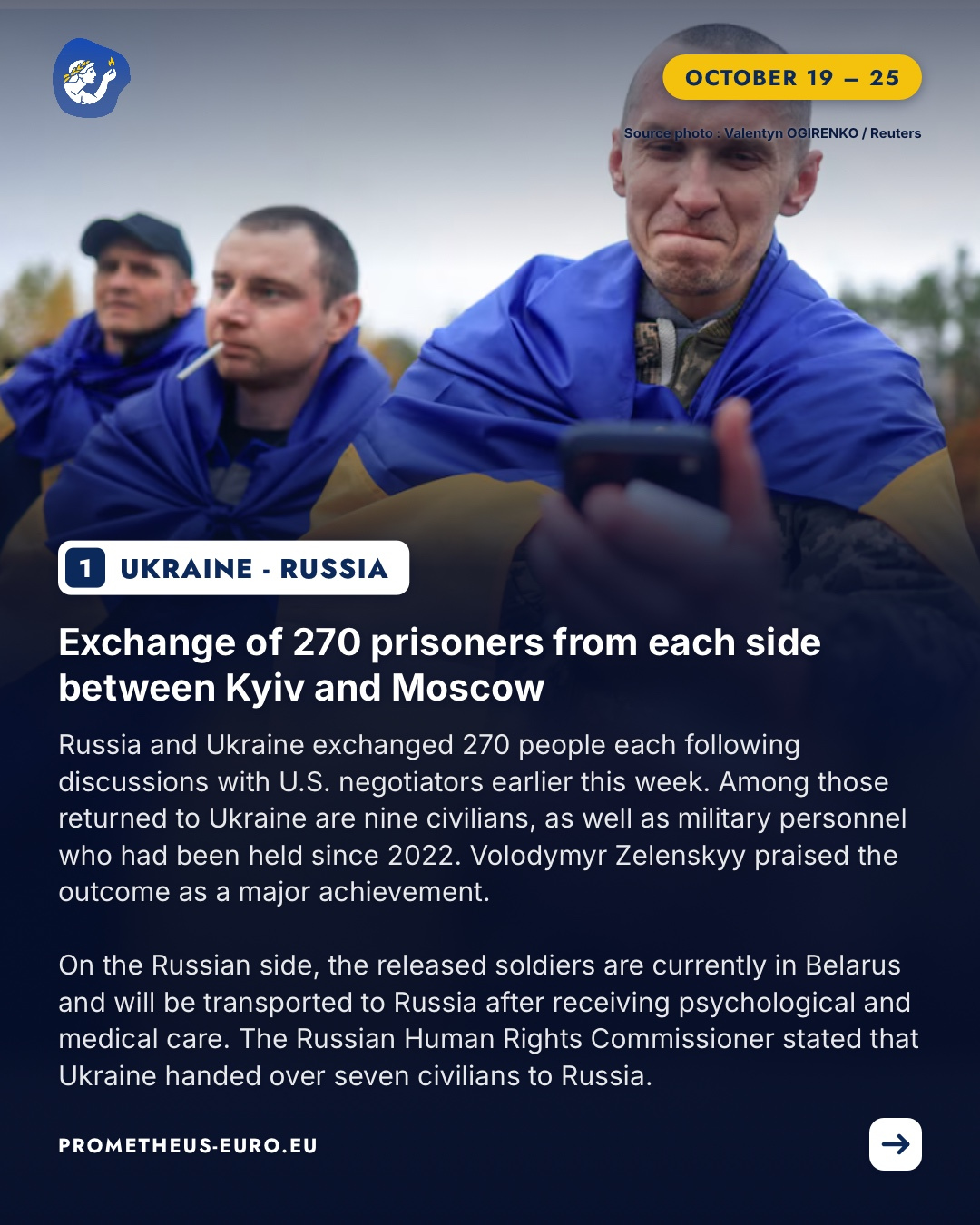
  2. Ukraine - Russia

    Exchange of 270 prisoners from each side between Kyiv and Moscow

    Russia and Ukraine exchanged 270 people each following discussions with U.S. negotiators earlier this week. Among those returned to Ukraine are nine civilians, as well as military personnel who had been held since 2022. Volodymyr Zelenskyy praised the outcome as a major achievement.

    On the Russian side, the released soldiers are currently in Belarus and will be transported to Russia after receiving psychological and medical care. The Russian Human Rights Commissioner stated that Ukraine handed over seven civilians to Russia.

    Allikas : Reuters

  3. Technology

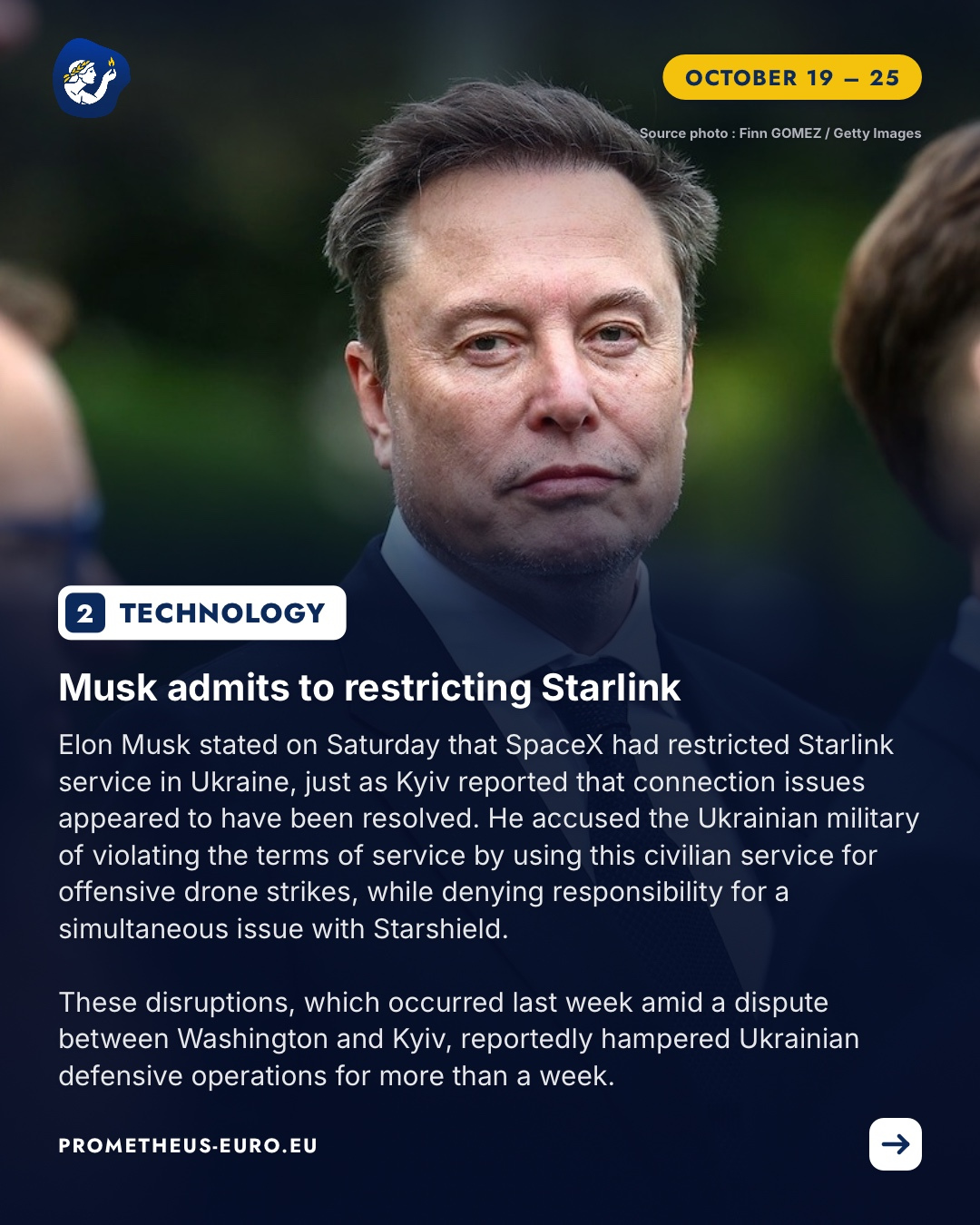
    Musk admits to restricting Starlink

    Elon Musk stated on Saturday that SpaceX had restricted Starlink service in Ukraine, just as Kyiv reported that connection issues appeared to have been resolved. He accused the Ukrainian military of violating the terms of service by using this civilian service for offensive drone strikes, while denying responsibility for a simultaneous issue with Starshield.

    These disruptions, which occurred last week amid a dispute between Washington and Kyiv, reportedly hampered Ukrainian defensive operations for more than a week.

    Allikas : BBC

  4. Society

    Another week of protest across Europe

    Once again this week, protests took place in cities across the Continent, from France to Albania, Italy, Spain, and Portugal. Pensions, housing, education, corruption, and opposition to war: the demands vary from country to country, but reflect a mix of grievances shared by many Europeans.

    Despite the precautions, bans, and heavy police presence observed in several European capitals, citizens have once again taken to the streets.

    Allikas : Euronews

  5. Middle east

    MEPs Call for the Houthis to be added to the Terrorist List

    On Thursday, the European Parliament approved a non-binding resolution calling for the Houthis to be added to the EU’s list of terrorist organizations and for all their funds to be frozen. The final decision rests with the member states, which must approve it unanimously.

    This request follows an escalation of attacks by the Iran-backed group against Saudi Arabia, which has led the United Kingdom to engage in defensive missions to protect Riyadh.

    Allikas : Euronews

  6. International prize

    The Sakharov Prize Awarded to the International Criminal Court

    On Thursday, October 22, the European Parliament awarded the Sakharov Prize for Freedom of Thought to the International Criminal Court (ICC) and its staff. This gesture comes as the United States is targeting the Court by announcing new sanctions aimed at paralyzing its day-to-day operations starting in April 2027.

    The Court may no longer have access to U.S. financial and digital services. Roberta Metsola reiterated that the EU is founded on respect for multilateralism and international institutions.

    Allikas : Le Monde

  7. International

    A new strategy for the Arctic

    The European Commission has unveiled a new strategy for the Arctic, which it considers its “northern neighborhood.” The plan is based on four priorities: security, climate, the economy, and the people.

    The EU promises to place local communities and indigenous peoples at the center of its approach, with more Erasmus+ opportunities for young people. It aims to work with its partner countries, including Norway, Canada, and the United States, in coordination with NATO.

    Allikas : Commission européenne

  8. Elections in Serbia

    In historic legislative elections, students challenge Aleksandar Vucic

    Serbs are set to go to the polls today for early parliamentary elections. The student protest movement is seeking to unseat populist leader Aleksandar Vucic, who has been in power since 2014. This election follows student-led protests against perceived corruption and authoritarian tendencies, which were sparked by the deaths of 16 people in 2024.

    Voter turnout stood at 27.3% at 11 a.m., compared with 15.1% at the same time during the 2023 election, and Vucic himself waited nearly two hours to cast his ballot.

    Allikas : Reuters

  9. Elections in Bulgaria

    Presidential election: the War in Ukraine and the economy take center stage in the vote

    There is a record number of 27 candidates, but the race is expected to come down to two of them: incumbent President Iliana Yotova, backed by Prime Minister Rumen Radev’s party, who seeks dialogue with Moscow and opposes military aid to Ukraine; and former interim Prime Minister Andrey Gyurov, backed by the pro-Western opposition.

    To win, a candidate needs a turnout of more than 50% and a majority of the votes, but the expected turnout is less than 40%; a runoff election is therefore likely on November 1.

    Allikas : Euronews

prometheus.fr Euro Daily Flash · Versioon: English
Euro Daily Flash — 24 oktoober 2026 : France: Renewed tensions over social unrest ; Ukraine–Russia: Local ceasefire to allow evacuations ; European Union: Brussels prepares new trade defence tool against China ; European Union: Member States move…
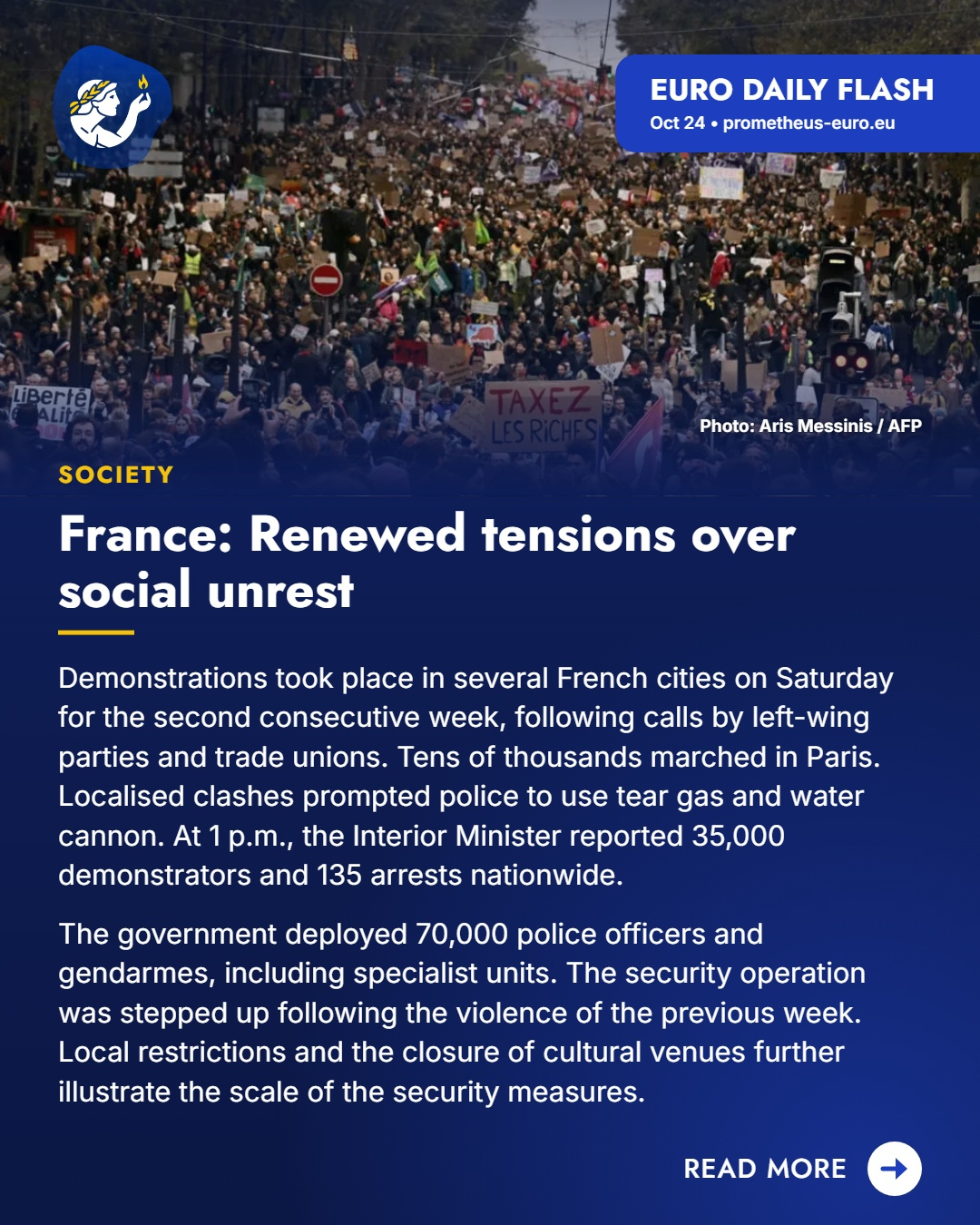
SOCIETY — France: Renewed tensions over social unrest. Demonstrations took place in several French cities on Saturday for the second consecutive week, following calls by left-wing parties and trade unions. Tens of thousands marched in Paris…
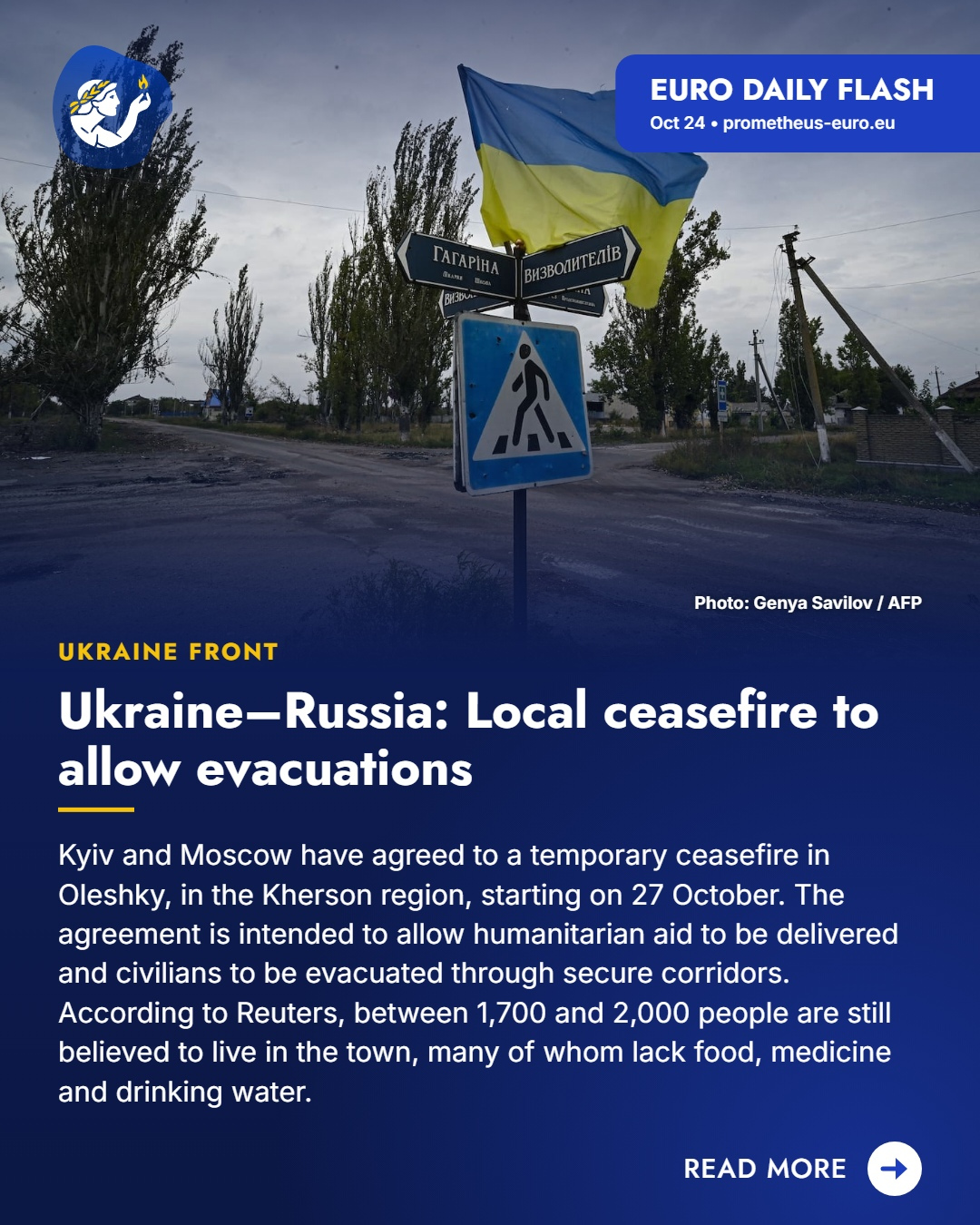
UKRAINE FRONT — Ukraine–Russia: Local ceasefire to allow evacuations. Kyiv and Moscow have agreed to a temporary ceasefire in Oleshky, in the Kherson region, starting on 27 October. The agreement is intended to allow humanitarian aid to be…
INTERNATIONAL TRADE — European Union: Brussels prepares new trade defence tool against China. Meeting in Dublin on 22 and 23 October, EU trade ministers discussed economic relations with China and preparations for the EU–Canada summit on 29 and 30…
BUSINESS — European Union: Member States move towards a single European framework for businesses. Member States have adopted their negotiating mandate on the “28th regime”, an optional framework designed to make it easier to establish and grow…
SECURITY — Germany: Merz condemns Russian attempts to destabilise the country. On 24 October, Chancellor Friedrich Merz said Germany was facing growing threats, including political extremism and what he described as Russia’s daily efforts to…
SOCIETY — Italy: 500 additional troops deployed in Milan following violence. Further demonstrations took place on 24 October in Milan, Rome, Turin and Naples over the rising cost of living, low wages and military spending. In Milan, Giorgia…
PENSIONS — Spain: Demonstration calls for higher pensions. Thousands of people demonstrated in Madrid at the call of the Coordinadora Estatal por la Defensa del Sistema Público de Pensiones (State Coordination Platform for the Defence of the Public…
PUBLIC FINANCES — France: Moody’s maintains sovereign rating but keeps negative outlook. Moody’s has maintained France’s rating at Aa3, avoiding a downgrade that some observers had feared. However, the agency has kept its outlook negative amid high…
CLIMATE — United Kingdom: Two successive storms threaten infrastructure and transport. Following Storm Austen, more than 4,200 customers in central and southern England were still without electricity on the morning of 24 October. Strong winds and…
PromethEUs — jälgi Euroopa uudiseid Instagramis ja LinkedInis

Ole esimene, kellele see meeldib

Euroopa uudised, 24 oktoober 2026 — France: Renewed tensions over social unrest

prometheus.fr 🇪🇺 EUROPE | 8 European stories to follow on 24 October 2026

⚠️ Social unrest: In France, 70,000 police officers and gendarmes have been deployed to police demonstrations continuing in several cities. In Italy, a further 500 military personnel have been sent to Milan following violence during earlier protests. In Spain, thousands of people are demonstrating in Madrid to defend the public pension system.

💶 Economy & public finances: Moody’s has maintained France’s sovereign credit rating at Aa3 but kept its outlook negative amid budgetary uncertainty. At EU level, Member States are making progress towards an optional legal framework designed to facilitate cross-border business expansion, while Brussels is preparing new trade defence tools.

🛡️ Security & geopolitics: Friedrich Merz has condemned Russian attempts to destabilise Germany. In Ukraine, a local ceasefire is due to allow civilians to be evacuated from Oleshky, in the Kherson region, from 27 October, but this does not signal a general truce.

🌦️ Climate & infrastructure: Following Storm Austen, thousands of households in the UK remain without electricity. Storm Boelo is now threatening Scotland and transport networks.

📲 Find out more about the key developments and their implications in our carousel.

PromethEUs | Making sense of European affairs.

\#Europe #EuropeanUnion #EuropeanNews #Geopolitics #Economy #Protests #Ukraine #France #Italy #Spain #Germany #UnitedKingdom #PromethEUs

Sources
2. Reuters, Le Monde
3. Reuters
4. Agence Europe
5. Agence Europe, the28thregime.eu
6. Reuters
7. Associated Press
8. RTVE
9. Reuters
10. SSEN, Met Office

Loe seda karusselli tekstina
  1. SOCIETY

    France: Renewed tensions over social unrest

    Demonstrations took place in several French cities on Saturday for the second consecutive week, following calls by left-wing parties and trade unions. Tens of thousands marched in Paris. Localised clashes prompted police to use tear gas and water cannon. At 1 p.m., the Interior Minister reported 35,000 demonstrators and 135 arrests nationwide.

    The government deployed 70,000 police officers and gendarmes, including specialist units. The security operation was stepped up following the violence of the previous week. Local restrictions and the closure of cultural venues further illustrate the scale of the security measures.

    Allikas : Reuters, Le Monde

  2. UKRAINE FRONT

    Ukraine–Russia: Local ceasefire to allow evacuations

    Kyiv and Moscow have agreed to a temporary ceasefire in Oleshky, in the Kherson region, starting on 27 October. The agreement is intended to allow humanitarian aid to be delivered and civilians to be evacuated through secure corridors. According to Reuters, between 1,700 and 2,000 people are still believed to live in the town, many of whom lack food, medicine and drinking water.

    Allikas : Reuters

  3. INTERNATIONAL TRADE

    European Union: Brussels prepares new trade defence tool against China

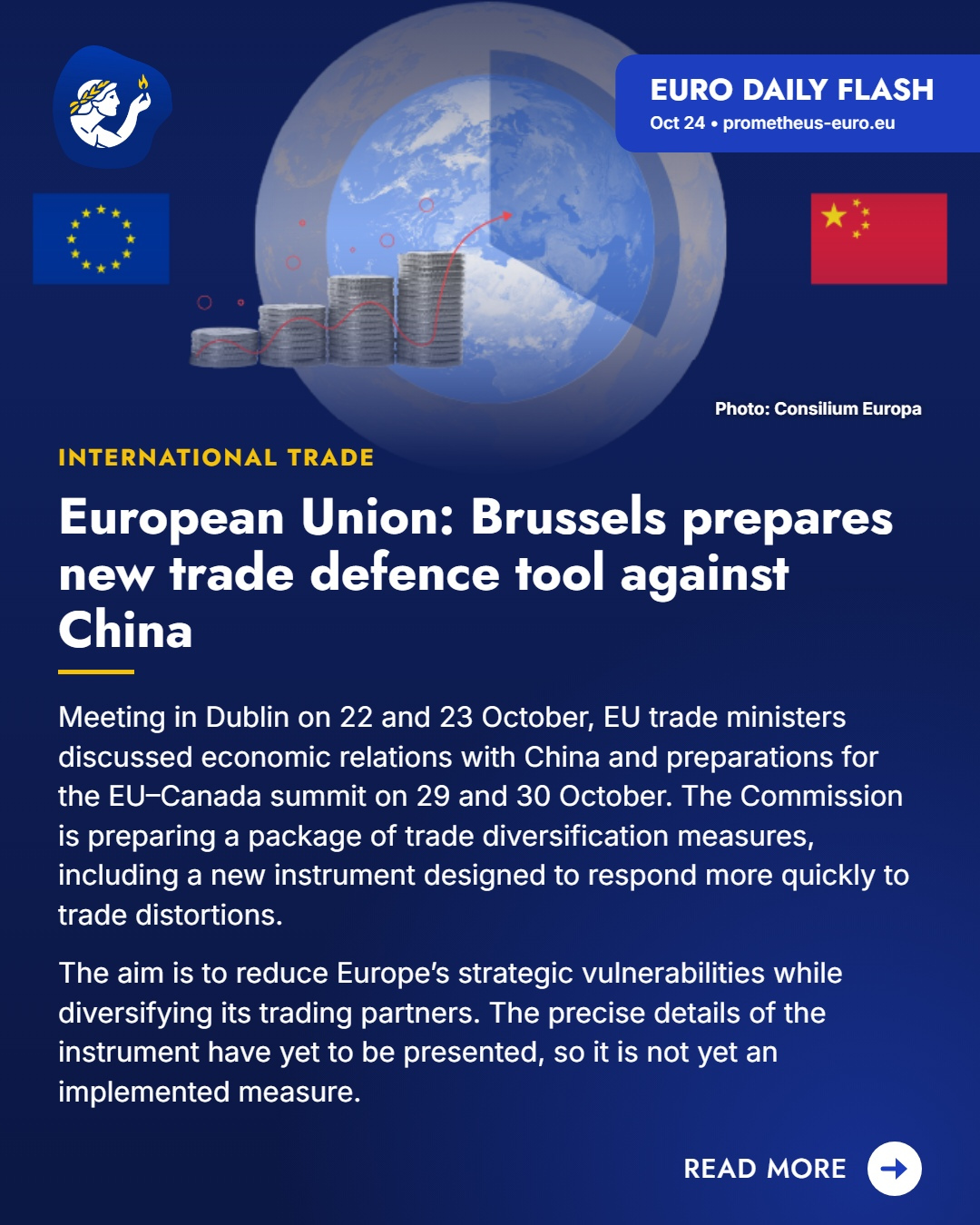
    Meeting in Dublin on 22 and 23 October, EU trade ministers discussed economic relations with China and preparations for the EU–Canada summit on 29 and 30 October. The Commission is preparing a package of trade diversification measures, including a new instrument designed to respond more quickly to trade distortions.

    The aim is to reduce Europe’s strategic vulnerabilities while diversifying its trading partners. The precise details of the instrument have yet to be presented, so it is not yet an implemented measure.

    Allikas : Agence Europe

  4. BUSINESS

    European Union: Member States move towards a single European framework for businesses

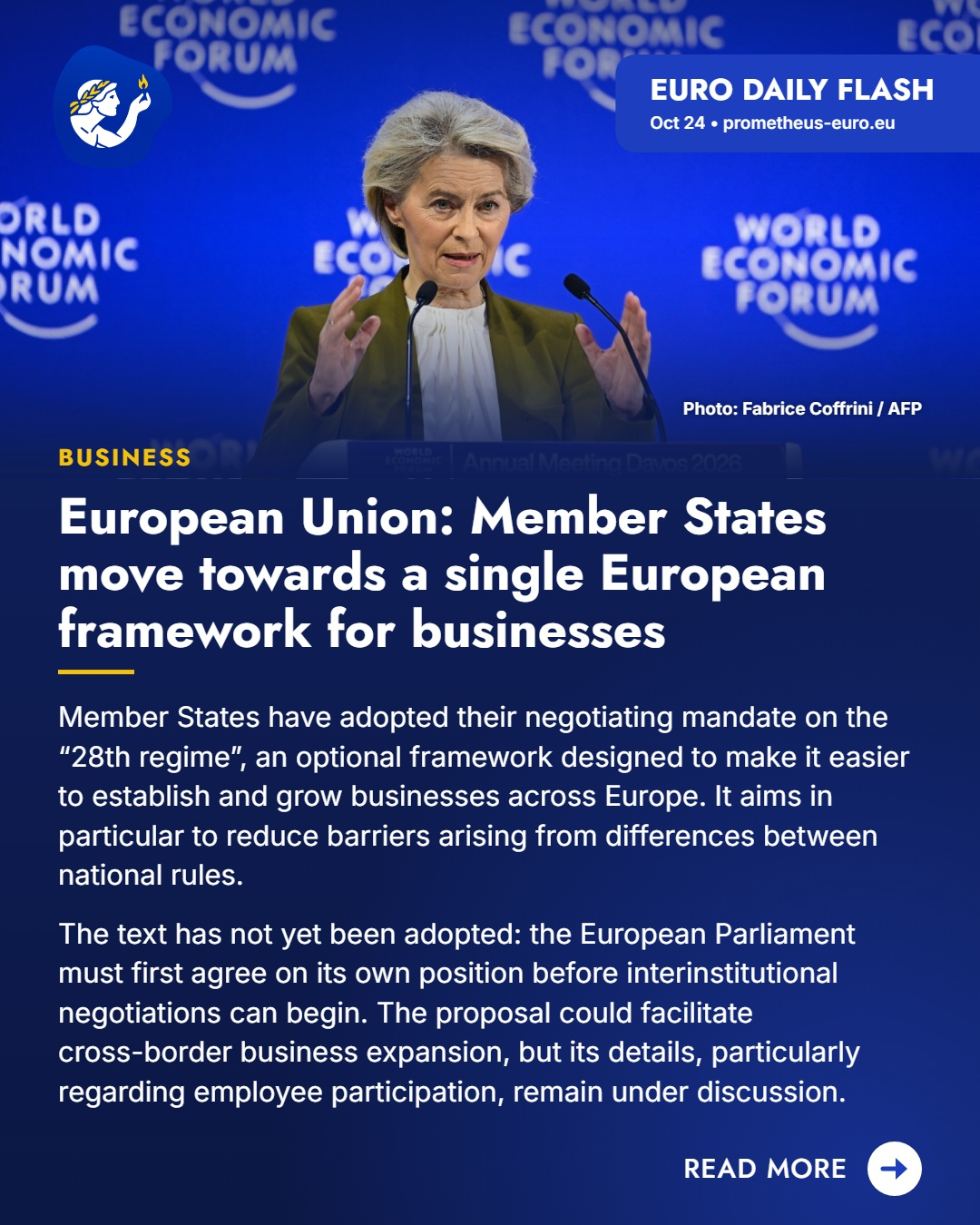
    Member States have adopted their negotiating mandate on the “28th regime”, an optional framework designed to make it easier to establish and grow businesses across Europe. It aims in particular to reduce barriers arising from differences between national rules.

    The text has not yet been adopted: the European Parliament must first agree on its own position before interinstitutional negotiations can begin. The proposal could facilitate cross-border business expansion, but its details, particularly regarding employee participation, remain under discussion.

    Allikas : Agence Europe, the28thregime.eu

  5. SECURITY

    Germany: Merz condemns Russian attempts to destabilise the country

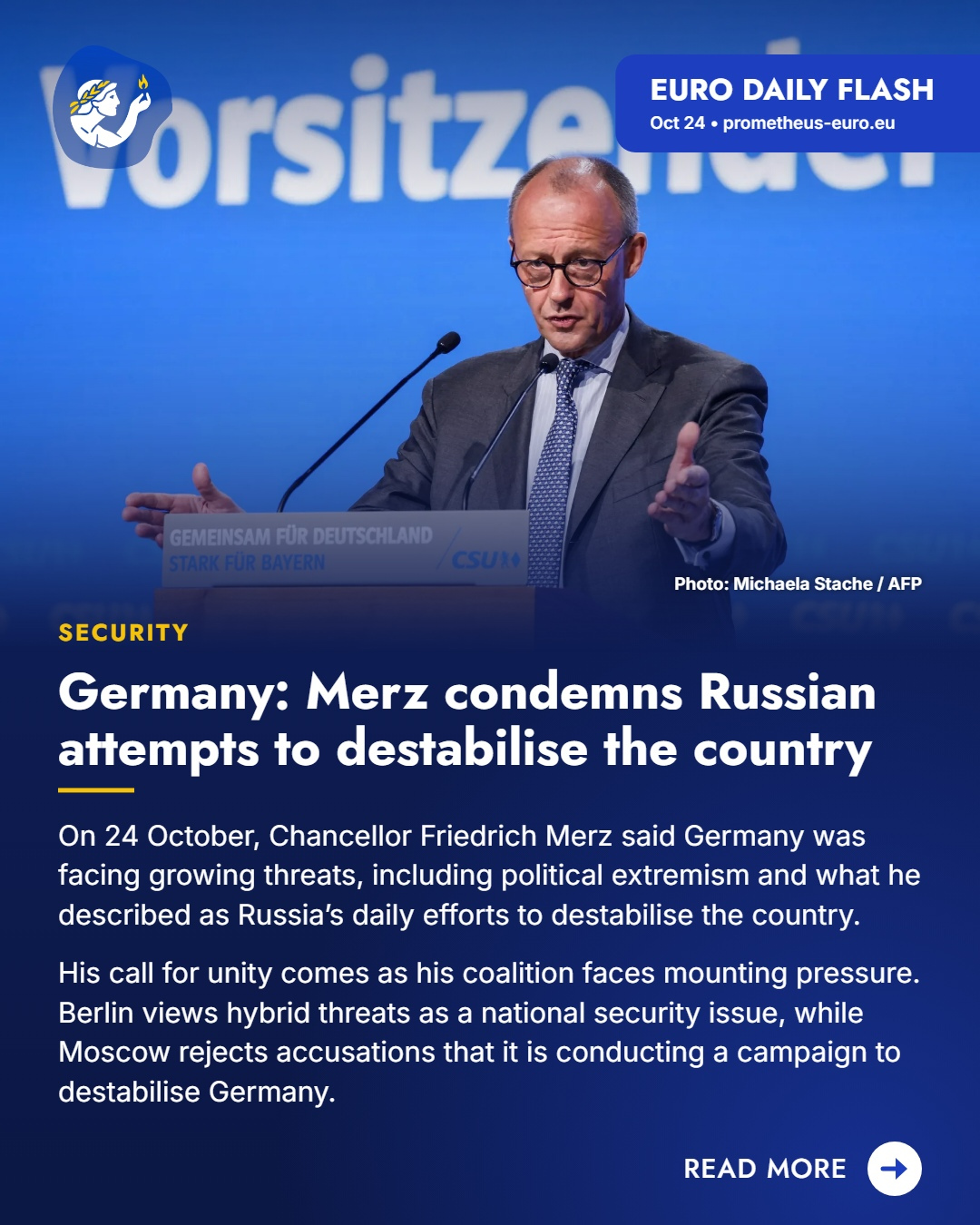
    On 24 October, Chancellor Friedrich Merz said Germany was facing growing threats, including political extremism and what he described as Russia’s daily efforts to destabilise the country.

    His call for unity comes as his coalition faces mounting pressure. Berlin views hybrid threats as a national security issue, while Moscow rejects accusations that it is conducting a campaign to destabilise Germany.

    Allikas : Reuters

  6. SOCIETY

    Italy: 500 additional troops deployed in Milan following violence

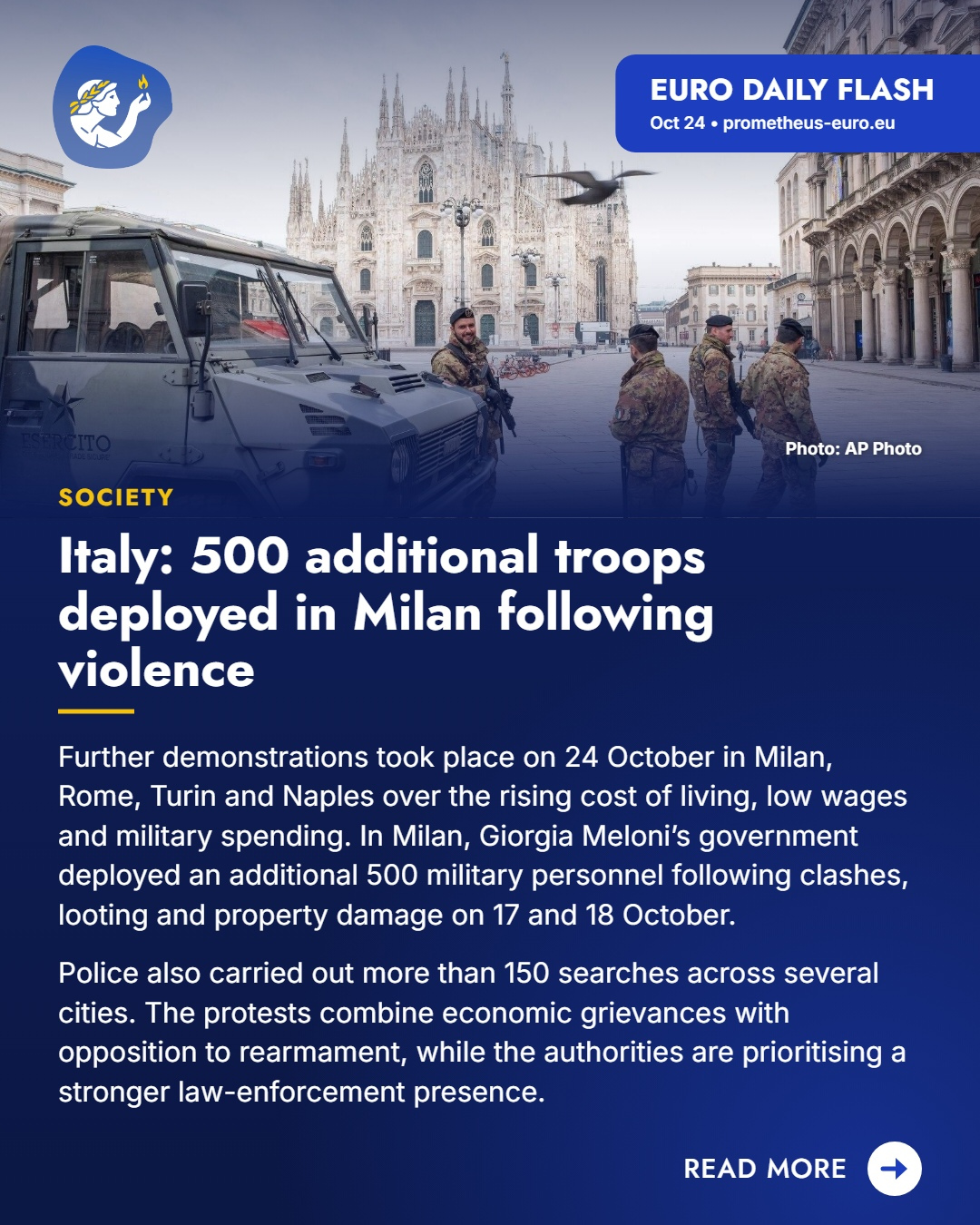
    Further demonstrations took place on 24 October in Milan, Rome, Turin and Naples over the rising cost of living, low wages and military spending. In Milan, Giorgia Meloni’s government deployed an additional 500 military personnel following clashes, looting and property damage on 17 and 18 October.

    Police also carried out more than 150 searches across several cities. The protests combine economic grievances with opposition to rearmament, while the authorities are prioritising a stronger law-enforcement presence.

    Allikas : Associated Press

  7. PENSIONS

    Spain: Demonstration calls for higher pensions

    Thousands of people demonstrated in Madrid at the call of the Coordinadora Estatal por la Defensa del Sistema Público de Pensiones (State Coordination Platform for the Defence of the Public Pension System). Organisers are demanding that pensions be adjusted in line with actual inflation and oppose any privatisation of the system.

    Attendance was estimated at 50,000 by the organisers and 25,000 by the government delegation. The demonstration has brought pensioners’ purchasing power and the long-term funding of the public system back into the spotlight.

    Allikas : RTVE

  8. PUBLIC FINANCES

    France: Moody’s maintains sovereign rating but keeps negative outlook

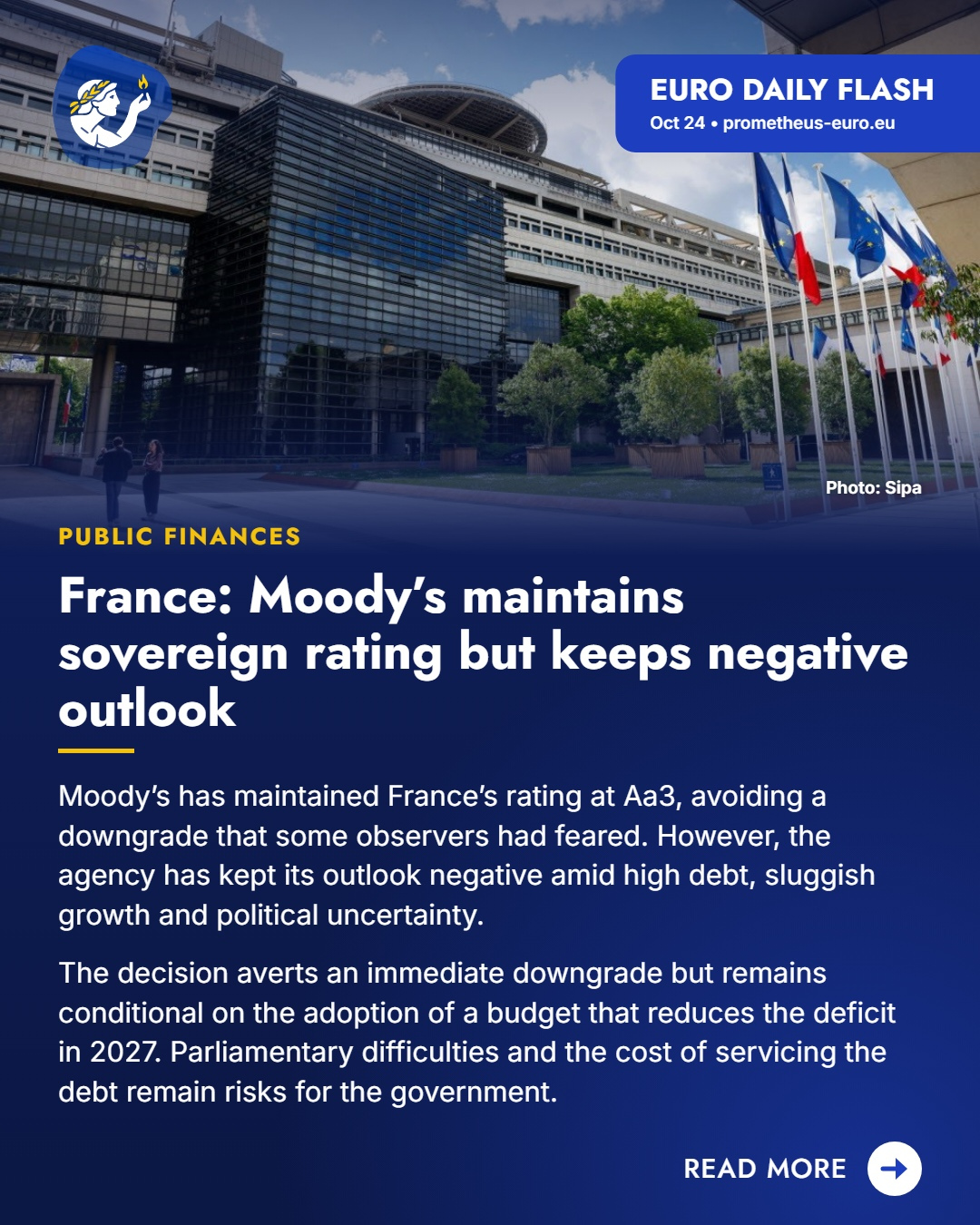
    Moody’s has maintained France’s rating at Aa3, avoiding a downgrade that some observers had feared. However, the agency has kept its outlook negative amid high debt, sluggish growth and political uncertainty.

    The decision averts an immediate downgrade but remains conditional on the adoption of a budget that reduces the deficit in 2027. Parliamentary difficulties and the cost of servicing the debt remain risks for the government.

    Allikas : Reuters

  9. CLIMATE

    United Kingdom: Two successive storms threaten infrastructure and transport

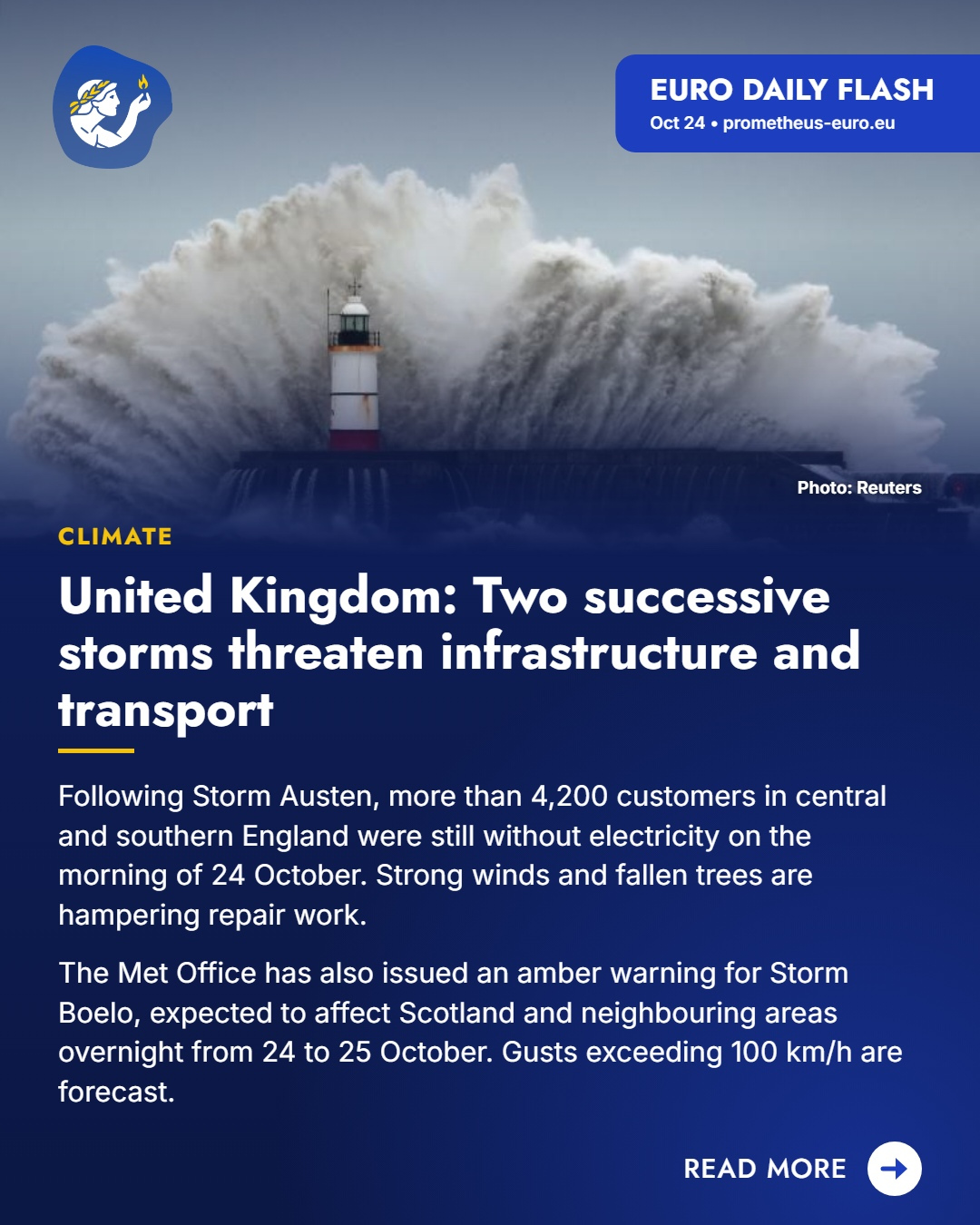
    Following Storm Austen, more than 4,200 customers in central and southern England were still without electricity on the morning of 24 October. Strong winds and fallen trees are hampering repair work.

    The Met Office has also issued an amber warning for Storm Boelo, expected to affect Scotland and neighbouring areas overnight from 24 to 25 October. Gusts exceeding 100 km/h are forecast.

    Allikas : SSEN, Met Office

prometheus.fr Analüüs · Versioon: English
Analüüs — 23 oktoober 2026 : Serbia: Understanding the political crisis ahead of the 25 Oct. 2026 elections
From Novi Sad to the ballot box. On 25 October, Serbian voters will elect their Parliament in a snap election contested by, among others, the Serbian Progressive Party (SNS), associated with Aleksandar Vučić, and the student list “Student List…
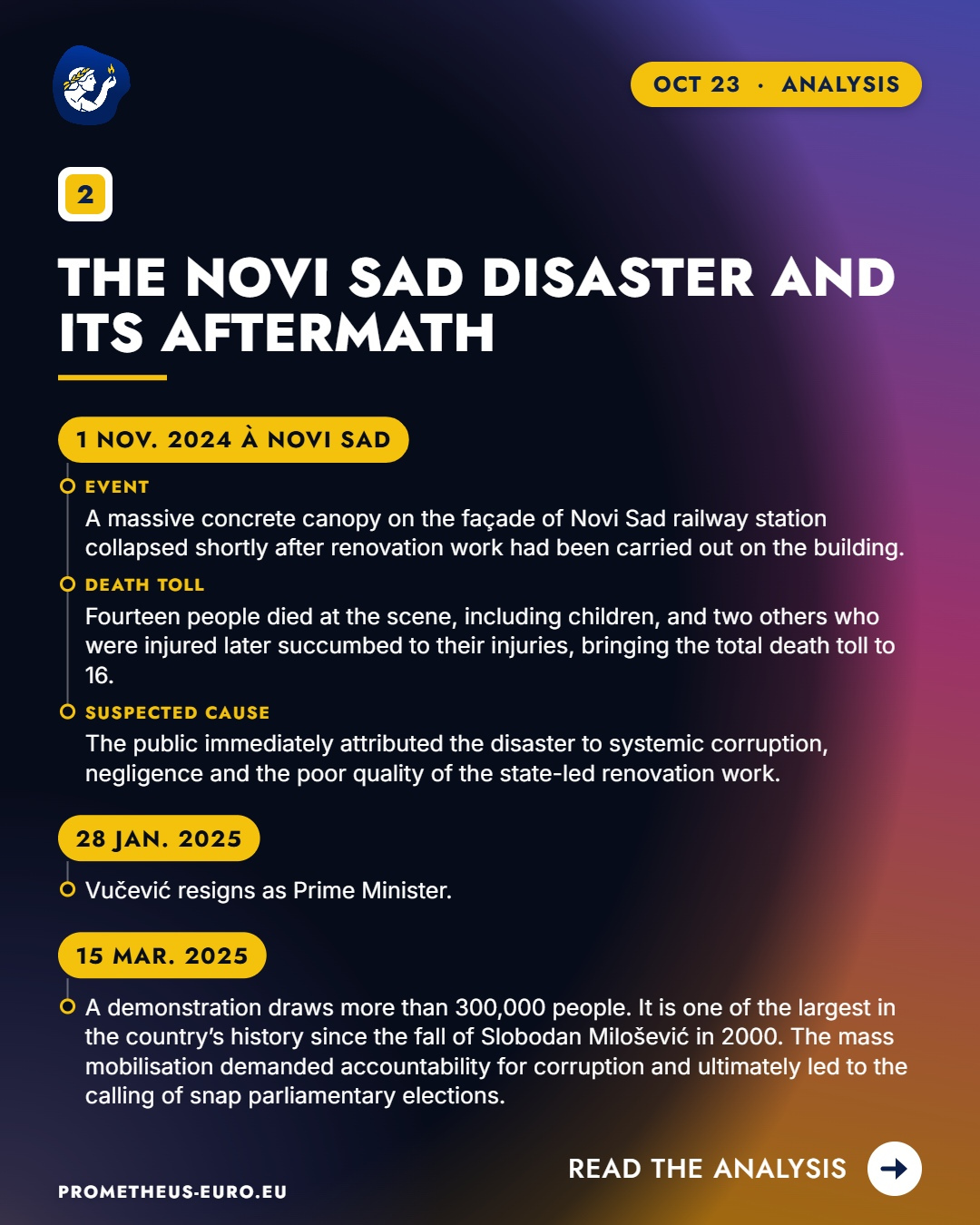
The Novi Sad disaster and its aftermath. 1 Nov. 2024 à Novi Sad Event : A massive concrete canopy on the façade of Novi Sad railway station collapsed shortly after renovation work had been carried out on the building. Death toll : Fourteen people…
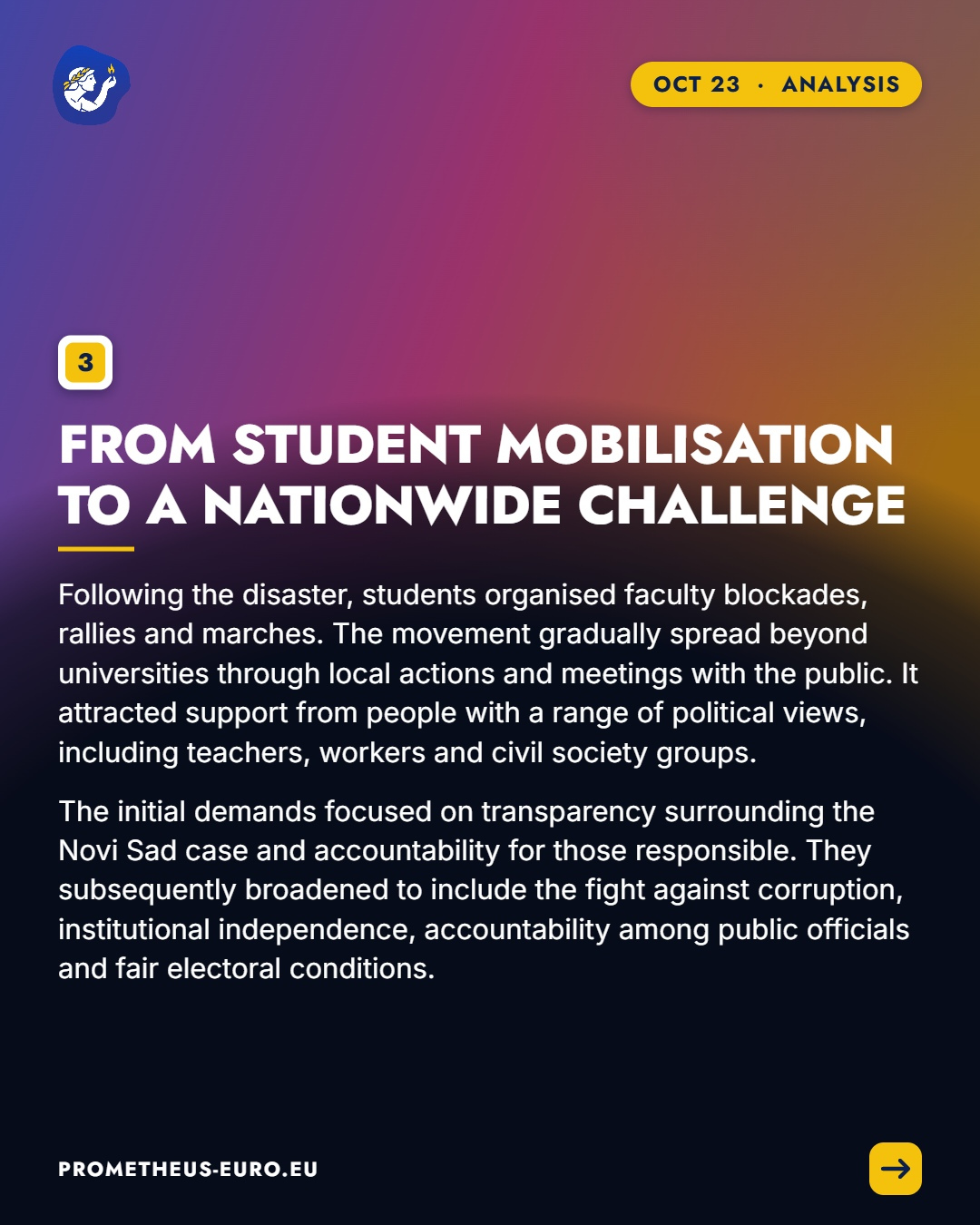
From student mobilisation to a nationwide challenge. Following the disaster, students organised faculty blockades, rallies and marches. The movement gradually spread beyond universities through local actions and meetings with the public. It…
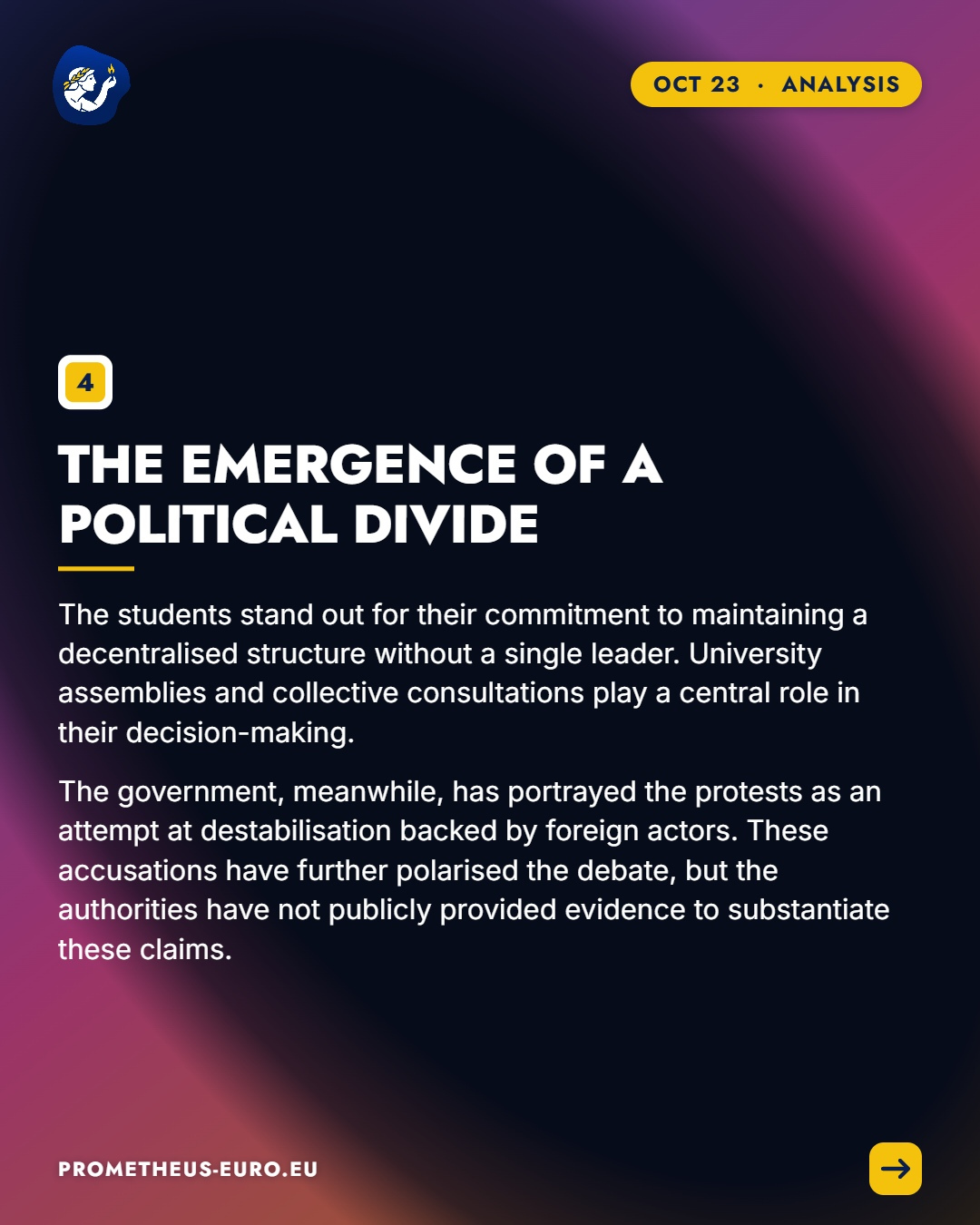
The emergence of a political divide. The students stand out for their commitment to maintaining a decentralised structure without a single leader. University assemblies and collective consultations play a central role in their decision-making. The…
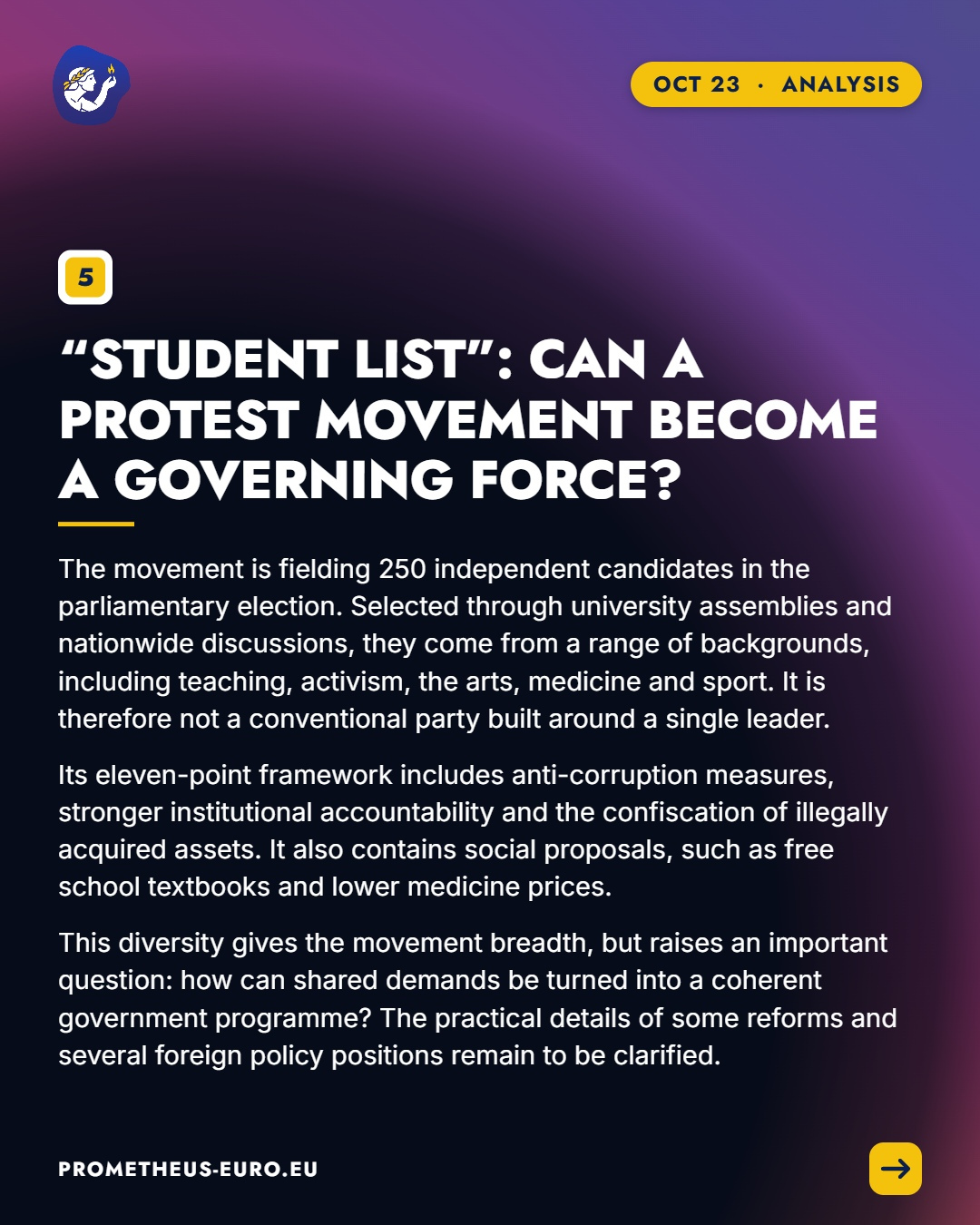
“Student List”: Can a protest movement become a governing force?. The movement is fielding 250 independent candidates in the parliamentary election. Selected through university assemblies and nationwide discussions, they come from a range of…
Aleksandar Vučić and Serbia’s political system. The SNS has been in power since 2012, and Aleksandar Vučić has dominated Serbian politics for more than a decade, first as Prime Minister and then as President from 2017. On 27 September 2026, Vučić…
Electoral conditions at the heart of the controversy. In its pre-election report published on 22 October, the independent Serbian organisation CRTA describes a campaign marked by intimidation, violence, pressure on voters and highly unequal access…
A significant imbalance in media coverage. The authorities received 72% of the airtime devoted to political actors on national television channels, compared with 28% for the opposition.
Electoral integrity. According to CRTA, the electoral register was closed with 6,450,523 voters and had not been audited beforehand. The organisation also reported incorrectly listed polling station addresses and potential obstacles to voting…
Why the crisis also matters to the European Union. Serbia has officially been a candidate for European Union membership since 2009. Its path towards accession nevertheless remains hindered by concerns about judicial independence, the fight against…
The vote: the first step in an uncertain transition. The election will not automatically resolve Serbia’s political crisis. Several factors will be decisive: turnout, the conduct of the vote, any challenges to the result, the response of state…
PromethEUs — jälgi Euroopa uudiseid Instagramis ja LinkedInis

Ole esimene, kellele see meeldib

Euroopa analüüs, 23 oktoober 2026 — Serbia: Understanding the political crisis ahead of the 25 Oct. 2026 elections

prometheus.fr 🇷🇸 SERBIA | Political crisis: Can the students end fourteen years of SNS dominance?

Since the Novi Sad disaster in November 2024, the student movement has become a national political force, denouncing corruption and calling for more transparent institutions. The rally in Belgrade on 22 October, just three days before the parliamentary elections, illustrates the scale of this mobilisation.

⚖️ But with an uneven electoral playing field, concerns over the integrity of the vote and uncertainty about the movement’s ability to govern, the outcome of this confrontation remains uncertain.

🇪🇺 Beyond domestic politics, the crisis also raises questions about the rule of law, relations with Brussels and Serbia’s European future.

🔎 In this analysis, we examine the origins of the mobilisation, the students’ demands, Serbia’s political system and the stakes of the 25 October elections.

PromethEUs | Making sense of European affairs.

#Serbia #Belgrade #Politics #Democracy #Elections #StudentMovement #AntiCorruption #RuleOfLaw #EuropeanUnion #Geopolitics #PromethEUs

Sources
2. Reuters, AFP
3. Reuters, Serbian Government
4. OSW, Reuters
5. Reuters, The Guardian
6. OSW, Reuters
7. Reuters, OSW
8. CRTA
9. CRTA
10. CRTA, Associated Press, OSCE/ODIHR
11. European Commission, Reuters
12. OSCE/ODIHR, Reuters, AP

Loe seda karusselli tekstina
  1. Serbia: Understanding the political crisis ahead of the 25 Oct. 2026 elections

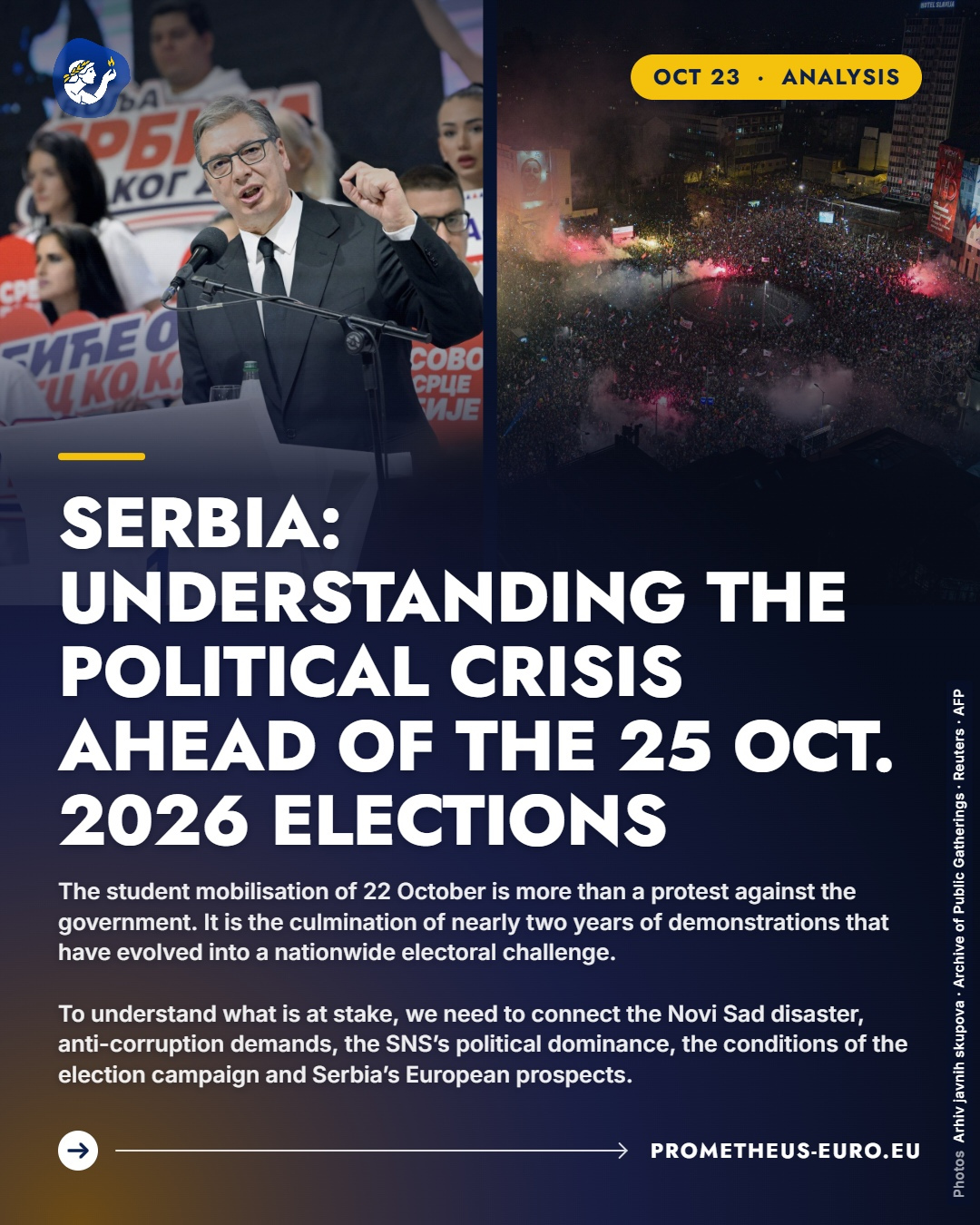
    The student mobilisation of 22 October is more than a protest against the government. It is the culmination of nearly two years of demonstrations that have evolved into a nationwide electoral challenge.

    To understand what is at stake, we need to connect the Novi Sad disaster, anti-corruption demands, the SNS’s political dominance, the conditions of the election campaign and Serbia’s European prospects.

  2. From Novi Sad to the ballot box

    On 25 October, Serbian voters will elect their Parliament in a snap election contested by, among others, the Serbian Progressive Party (SNS), associated with Aleksandar Vučić, and the student list “Student List – Students Are Winning” (“*Studentska lista*”).

    The movement emerged following a railway disaster in November 2024. It has gradually developed into a national political force, challenging alleged corruption and the functioning of state institutions. The rally in Belgrade on 22 October, the students’ final major campaign event, illustrates the scale of the mobilisation.

    Allikas : Reuters, AFP

  3. The Novi Sad disaster and its aftermath

    1 Nov. 2024 à Novi Sad
    Event : A massive concrete canopy on the façade of Novi Sad railway station collapsed shortly after renovation work had been carried out on the building.
    Death toll : Fourteen people died at the scene, including children, and two others who were injured later succumbed to their injuries, bringing the total death toll to 16.
    Suspected cause : The public immediately attributed the disaster to systemic corruption, negligence and the poor quality of the state-led renovation work.
    28 Jan. 2025
    : Vučević resigns as Prime Minister.
    15 Mar. 2025
    : A demonstration draws more than 300,000 people. It is one of the largest in the country’s history since the fall of Slobodan Milošević in 2000. The mass mobilisation demanded accountability for corruption and ultimately led to the calling of snap parliamentary elections.

    Allikas : Reuters, Serbian Government

  4. From student mobilisation to a nationwide challenge

    Following the disaster, students organised faculty blockades, rallies and marches. The movement gradually spread beyond universities through local actions and meetings with the public. It attracted support from people with a range of political views, including teachers, workers and civil society groups.

    The initial demands focused on transparency surrounding the Novi Sad case and accountability for those responsible. They subsequently broadened to include the fight against corruption, institutional independence, accountability among public officials and fair electoral conditions.

    Allikas : OSW, Reuters

  5. The emergence of a political divide

    The students stand out for their commitment to maintaining a decentralised structure without a single leader. University assemblies and collective consultations play a central role in their decision-making.

    The government, meanwhile, has portrayed the protests as an attempt at destabilisation backed by foreign actors. These accusations have further polarised the debate, but the authorities have not publicly provided evidence to substantiate these claims.

    Allikas : Reuters, The Guardian

  6. “Student List”: Can a protest movement become a governing force?

    The movement is fielding 250 independent candidates in the parliamentary election. Selected through university assemblies and nationwide discussions, they come from a range of backgrounds, including teaching, activism, the arts, medicine and sport. It is therefore not a conventional party built around a single leader.

    Its eleven-point framework includes anti-corruption measures, stronger institutional accountability and the confiscation of illegally acquired assets. It also contains social proposals, such as free school textbooks and lower medicine prices.

    This diversity gives the movement breadth, but raises an important question: how can shared demands be turned into a coherent government programme? The practical details of some reforms and several foreign policy positions remain to be clarified.

    Allikas : OSW, Reuters

  7. Aleksandar Vučić and Serbia’s political system

    The SNS has been in power since 2012, and Aleksandar Vučić has dominated Serbian politics for more than a decade, first as Prime Minister and then as President from 2017.

    On 27 September 2026, Vučić resigned as President to lead his list’s parliamentary campaign and seek the post of Prime Minister. Ana Brnabić, the Speaker of Parliament, is serving as acting President. A separate presidential election is due to be held before the end of the year.

    His opponents accuse him of concentrating power, putting pressure on the media and weakening checks and balances. The government rejects these accusations and points to stability, infrastructure development and its economic record.

    Allikas : Reuters, OSW

  8. Electoral conditions at the heart of the controversy

    In its pre-election report published on 22 October, the independent Serbian organisation CRTA describes a campaign marked by intimidation, violence, pressure on voters and highly unequal access to the media.

    During the period covered, its observers recorded 116 incidents of physical or verbal violence across 34 cities and municipalities. The authorities also received more favourable media coverage.

    These findings concern the conditions under which the election is being contested. They do not, by themselves, prove that the result will be fraudulent.

    Allikas : CRTA

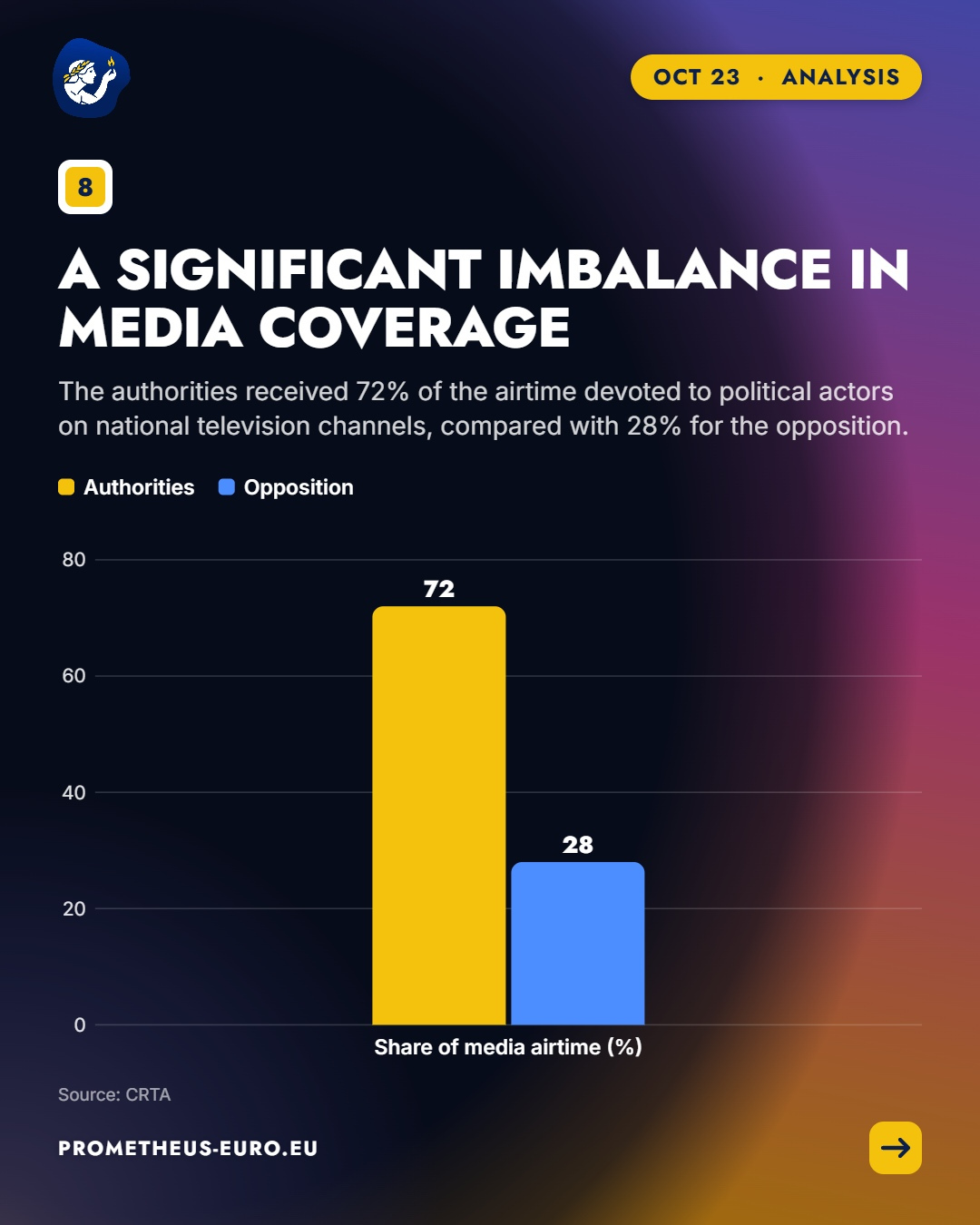
  9. A significant imbalance in media coverage

    The authorities received 72% of the airtime devoted to political actors on national television channels, compared with 28% for the opposition.

    Allikas : CRTA

  10. Electoral integrity

    According to CRTA, the electoral register was closed with 6,450,523 voters and had not been audited beforehand. The organisation also reported incorrectly listed polling station addresses and potential obstacles to voting. These issues make it harder to verify the reliability of the electoral process.

    The OSCE/ODIHR, the European Union and representatives of the Council of Europe have also expressed concerns about campaign violence, threats, the safety of journalists and observers, allegations of surveillance and the accuracy of electoral rolls.

    Allikas : CRTA, Associated Press, OSCE/ODIHR

  11. Why the crisis also matters to the European Union

    Serbia has officially been a candidate for European Union membership since 2009. Its path towards accession nevertheless remains hindered by concerns about judicial independence, the fight against corruption, media pluralism and checks and balances.

    In its 2026 Rule of Law Report, published in July, the European Commission highlighted persistent concerns about the autonomy of the prosecution service and political pressure on the judiciary.

    The geopolitical dimension further complicates matters: Belgrade maintains close relations with Russia and China while continuing to pursue EU membership.

    Allikas : European Commission, Reuters

  12. The vote: the first step in an uncertain transition

    The election will not automatically resolve Serbia’s political crisis. Several factors will be decisive: turnout, the conduct of the vote, any challenges to the result, the response of state institutions and the ability of the different lists to secure a parliamentary majority.

    An electoral victory would not, by itself, guarantee that the student list could govern without difficulty. Conversely, a contested result could trigger further protests. These are possible scenarios, not foregone outcomes.

    The OSCE/ODIHR is due to present its preliminary findings on 26 October. Another milestone lies ahead: following Vučić’s resignation, a presidential election must be held before the end of 2026.

    Allikas : OSCE/ODIHR, Reuters, AP