
 EN
EN 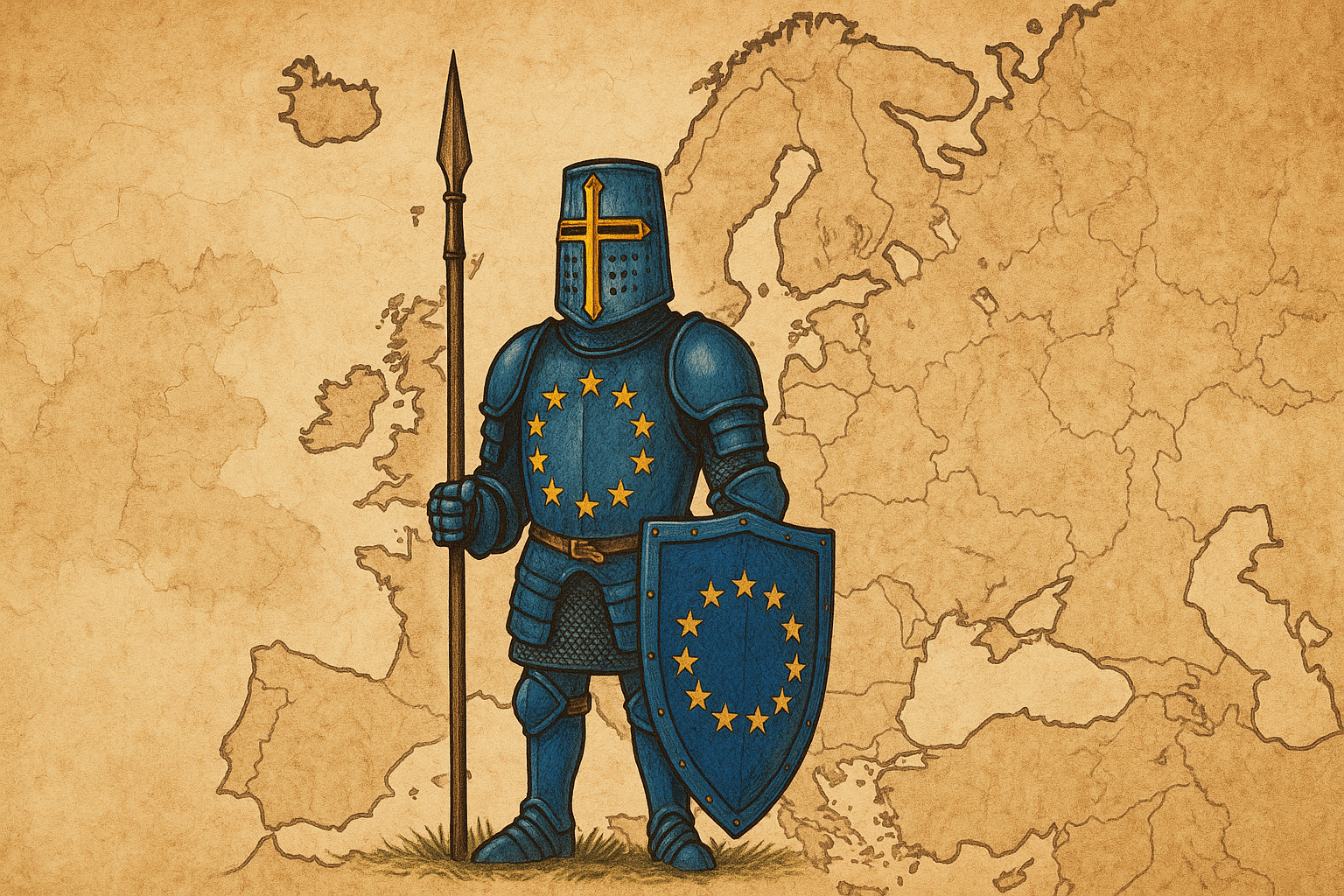
As the SAFE program mobilizes 150 billion euros for European rearmament, the question of the Union’s strategic autonomy is becoming increasingly pressing. Since the 2022 Versailles Summit, the Twenty-Seven have asserted their willingness to "take their destiny into their own hands" in the face of American uncertainties and Russian threats.
➡️ Military capabilities, nuclear deterrence, cooperation with NATO, industrial and energy sovereignty, CSDP missions: our new article analyzes in detail the conditions under which Europe could—or could not—defend itself alone.
🔍 We offer a first step in this reflection through a structured overview, based on European texts and a geopolitical vision that is both strategic and operational.
🧠 A must-read to understand the deep stakes of a Europe aiming to move beyond its economic framework to become a power.
Contents
The European Union's Defense Capabilities in the Era of the SAFE Program (Security Action for Europe)
Faced with geopolitical crises and the launch of the SAFE (Security Action for Europe) program, the question of the European Union's (EU) defense autonomy arises with acuity. The invasion of Ukraine by Russia in 2022 served as a catalyst, pushing Europeans to massively reinforce their military capabilities and defense industry.
In March 2022, at the Versailles summit, the leaders of the Twenty-Seven stated their willingness to "take more responsibility" for Europe's security while acknowledging that cooperation with NATO remains fundamental. Since then, European defense spending has surged: from 200 billion euros in 2021 to 320 billion in 2024, an effort that now rivals the Russian military budget.
The majority of EU countries now reach or exceed the target of 2% of GDP dedicated to defense set by NATO. But is this momentum enough to allow Europe to defend itself alone, without the support of the United States?
This article offers a structured analysis of this issue, addressing the conditions for an autonomous European defense by relying on both a macro (strategic, diplomatic) and micro (industrial, political) perspective.
1/6 - Towards a European Defense Without the United States?
Since the end of World War II, Europe has relied on the American umbrella via NATO to ensure its defense. However, the notion of European "strategic autonomy" has gained importance in recent years, especially in light of transatlantic uncertainties during the Trump presidency and the Russian threat.
For the EU to do without US military support, several conditions are necessary. First, a credible military capability: on this front, recent figures are encouraging. The combined defense budgets of EU countries now reach €320 billion per year, which, even in purchasing power parity, is of the same order of magnitude as the Russian effort, especially since Russia itself depends on imports (Iran, North Korea, China) for its weaponry. In other words, Europe already has the potential today to militarily deter Russia from attacking. Capability gaps (for example in air and missile defense) remain real, but they are in the process of being filled thanks to increased spending and joint projects.
European Legislation on Common Defense
In 2024, for the first time in history, the majority of EU countries dedicated more than 2% of their GDP to defense, thus complying with NATO commitments. This ramp-up in budget is accompanied by the launch in 2025 of a massive plan of 800 billion euros to "rearm Europe", including the SAFE common fund of €150 billion intended for joint arms procurement.
Next, a united political will is indispensable. Article 42 of the Treaty on European Union (introduced by the Treaty of Lisbon) provides for the progressive definition of a common defense policy and even the possibility of a common defense of the Union once the European Council decides so unanimously. This same article insists, however, on the compatibility of the EU with NATO, the "foundation of collective defense" for the countries that are members of it. In other words, legally and strategically, the EU is not intended to replace NATO, but to be able to act autonomously when necessary.
This autonomy passes through mechanisms such as the Permanent Structured Cooperation (PESCO), in which 26 Member States participate, aiming to harmonize their capabilities and increase their defense investments. In parallel, Article 42.7 of the Treaty on European Union (TEU) establishes a purely European mutual defense clause: if a Member State is the victim of armed aggression on its territory, the others have an obligation of aid and assistance by all the means in their power.
🛡️Article 42.7 (TEU): If a Member State is the victim of armed aggression on its territory, the other Member States shall have towards it an obligation of aid and assistance by all the means in their power, in accordance with Article 51 of the United Nations Charter. This shall not prejudice the specific character of the security and defense policy of certain Member States.
This clause has been invoked only once (by France after the 2015 attacks), demonstrating that Europeans recognize a duty of military solidarity among themselves, even if in practice NATO remains the ultimate guarantor of the continent.
Another factor of separation from the United States resides in the European takeover of NATO structures. Contrary to popular belief, the Atlantic Alliance could function without the Americans on an organizational level: Washington finances only about 16% of NATO's budget (i.e., ~€450 million out of €2.85 billion), a share that European Allies could perfectly well assume to keep the Alliance alive in their favor.
Some even point out that Europe, with over 1.5 million soldiers under combined flags, surpasses Russia in manpower and possesses cutting-edge technologies comparable to the United States in certain areas. Nevertheless, the dependence regarding key assets (intelligence, projection logistics, aerial refueling, integrated command) remains a major hurdle. The NATO intervention in Libya (2011) illustrated the Europeans' lack of support capabilities in the absence of American backing. It is precisely to address these shortcomings that the EU adopted the Strategic Compass in 2022, a doctrinal document setting a concrete roadmap by 2030 to strengthen Europe's capacity to act, for example by equipping itself with a Rapid Deployment Capacity of 5,000 troops.
Ultimately, the EU will only be able to defend itself alone if it continues to ramp up militarily, technologically, and politically. The current context seems to push in this direction: the American "pivot" towards the Indo-Pacific and doubts about Washington's future engagement are inciting Europeans to take their destiny into their own hands. Thus, in March 2025, faced with an American-Russian mediation deemed unsatisfactory in the Ukrainian conflict, some twenty European leaders met (with the United Kingdom) to define a common ceasefire initiative. British Prime Minister Keir Starmer himself mentioned the formation of a "coalition of the willing" ready to intensify their defense effort and sanctions against Russia.
These developments testify to a realization: Europe must be capable of acting militarily by its own means if necessary. However, it would be premature to bury the transatlantic alliance. In the best-case scenario, the EU will obtain the means for its autonomous defense while keeping the United States as an ally and force multiplier, which would doubly strengthen the continent's security.
References
- No sources yet.
No comments yet.